
Last updated August 25, 2026
Free on-site gate assessment - hinges, posts, and your LiftMaster or Nice gate operator checked before anything is quoted
The assessment is free and the quote is the invoice.

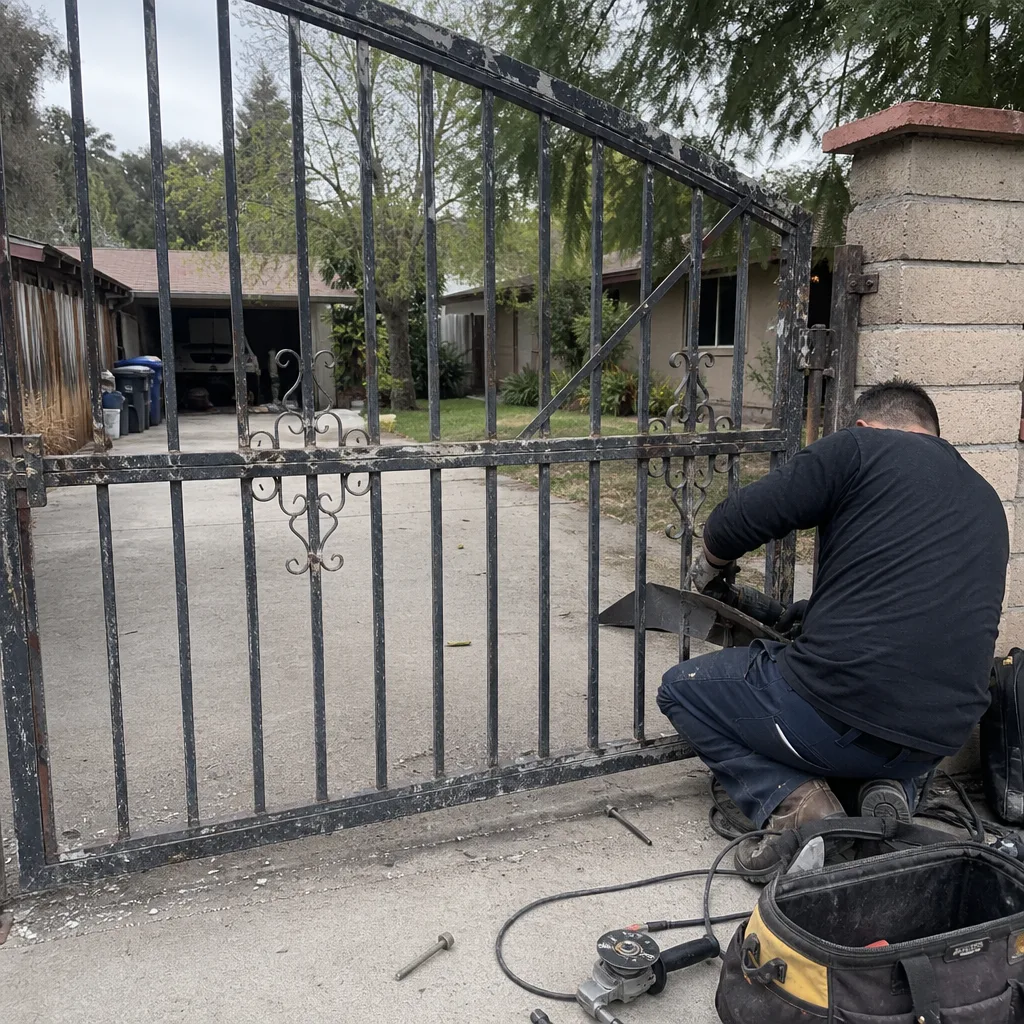 Before
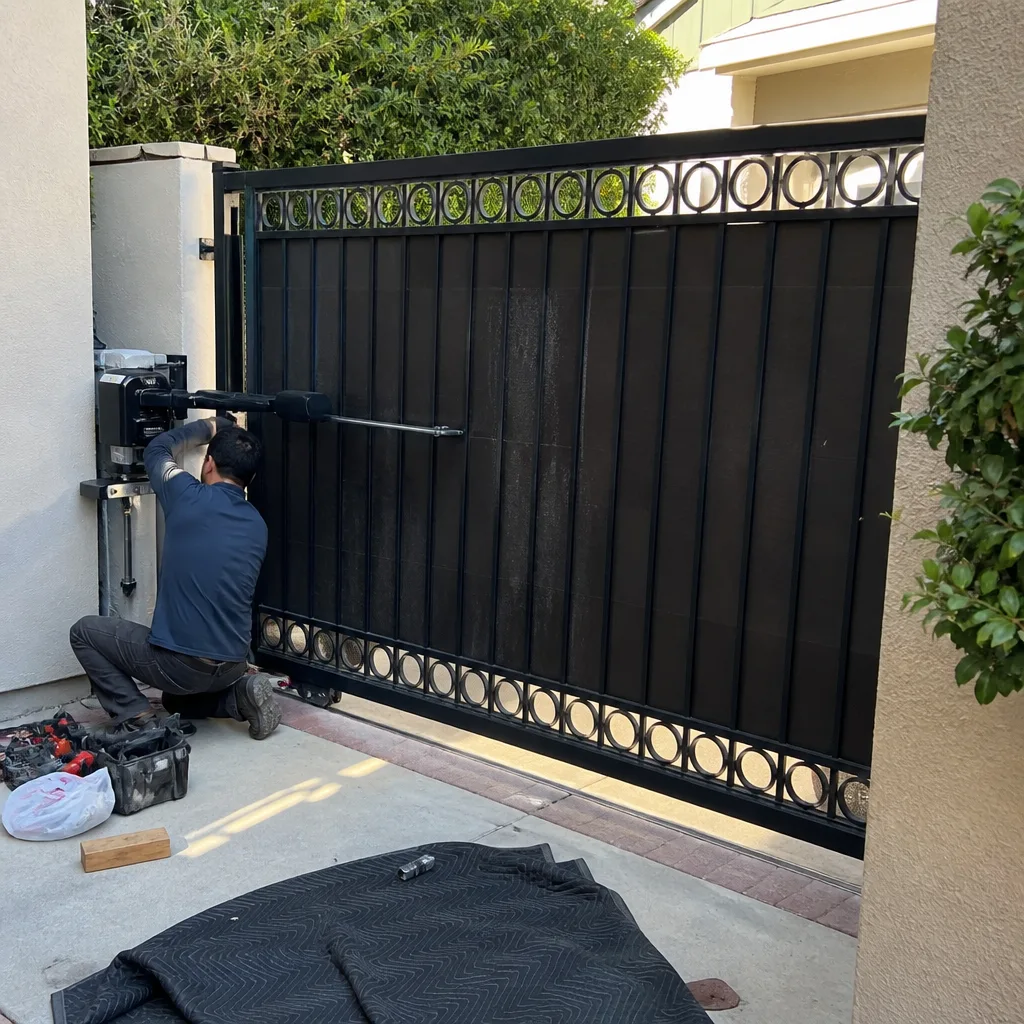 After
After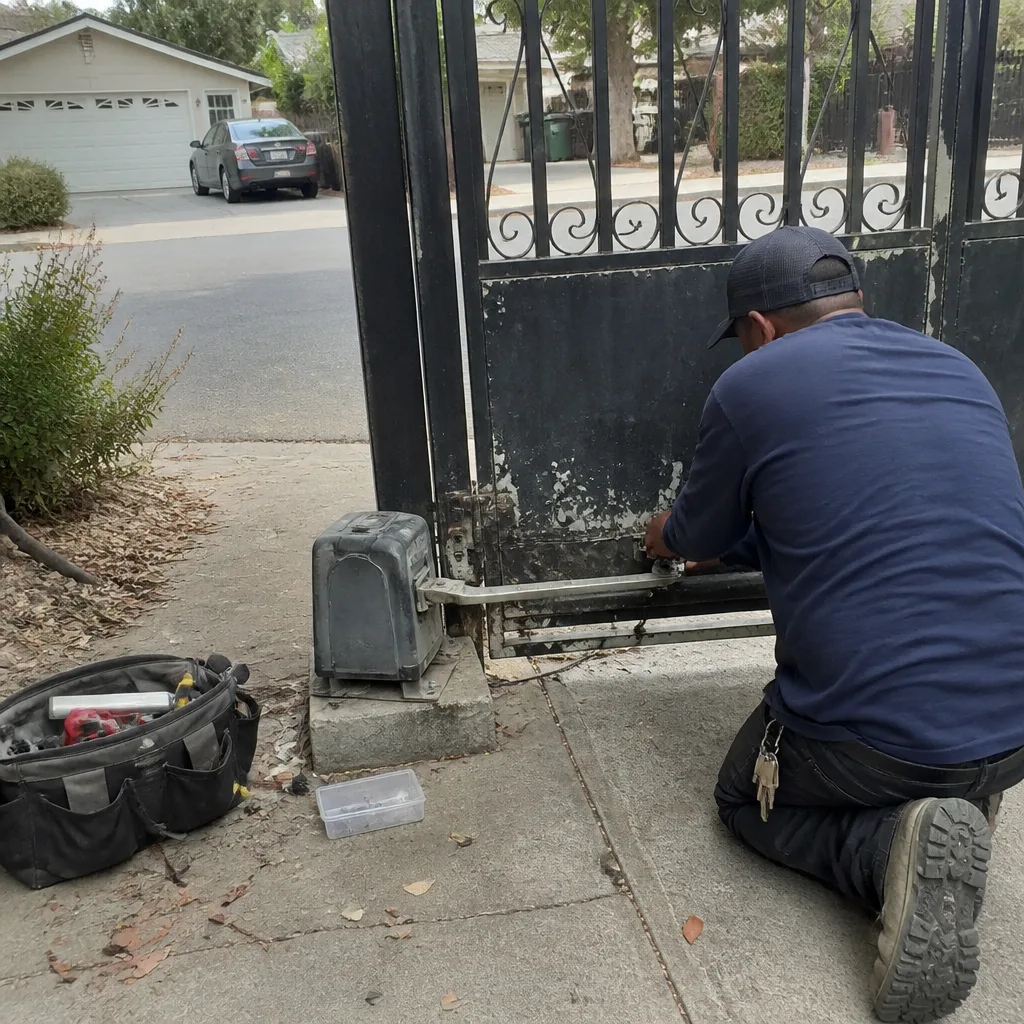 Before
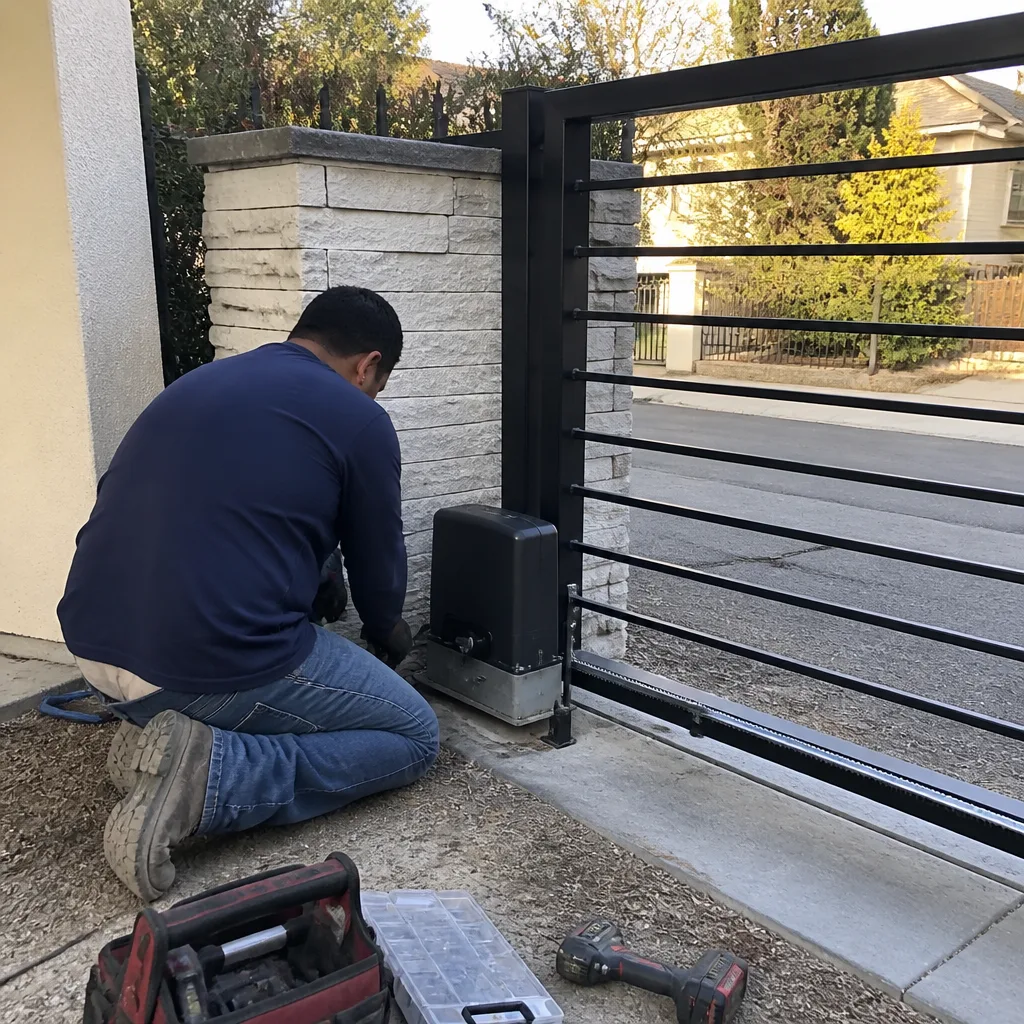 After
After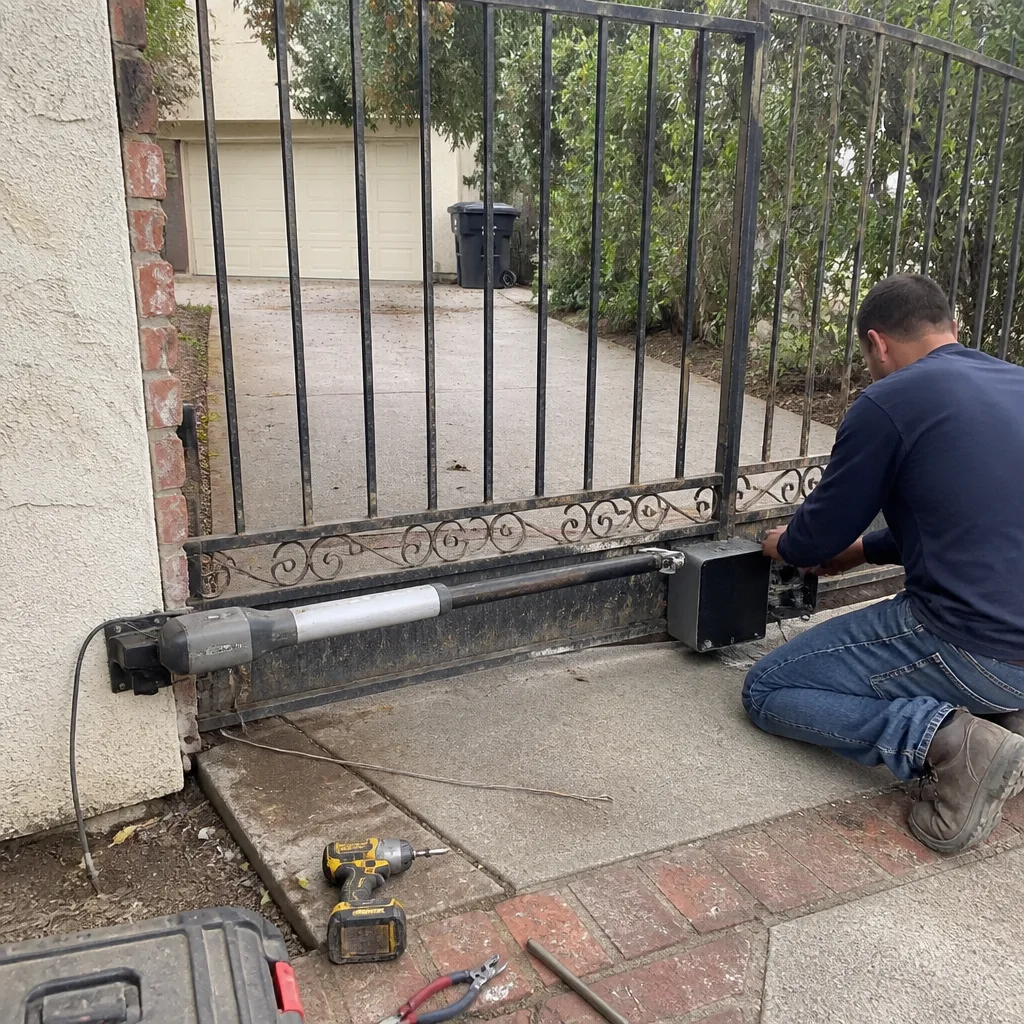 Before
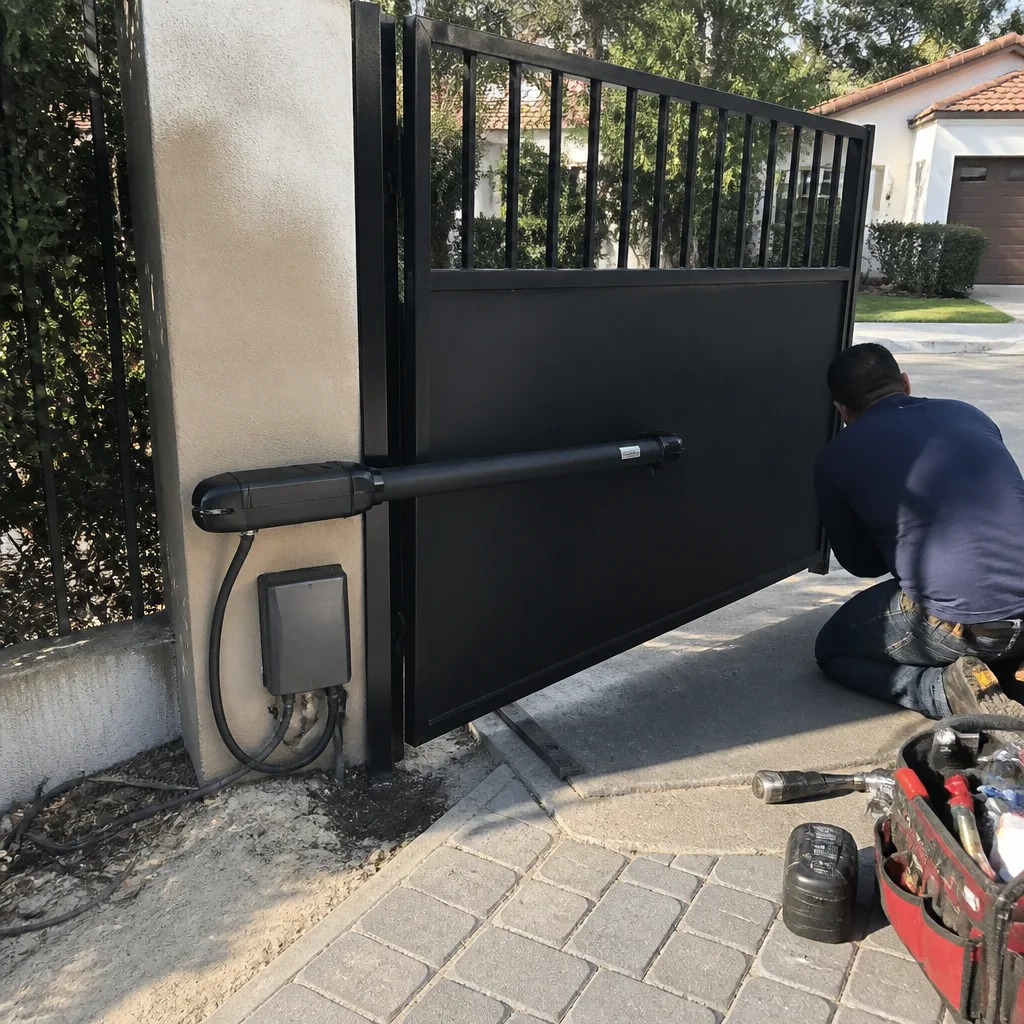 After
AfterGate Repair Maintenance Checklist for Tarzana Homeowners
A driveway gate in Tarzana fails almost twice as fast as the same gate would in, say, Calabasas or Encino. The reason isn’t the gate. It’s the dust. The fine, silty soil that drifts down from the Santa Monica Mountains works its way into hinge pins, roller tracks, and motor housings, grinding away at metal and electronics month after month. Most Tarzana homeowners don’t discover the damage until the gate refuses to open on a Monday morning. This guide gives you a season-by-season maintenance routine that catches problems early, plus the exact signs that mean a repair is already overdue.
Quick Answer
The core gate maintenance checklist for Tarzana homeowners comes down to six tasks: lubricate hinges and bearings twice a year, clear debris from the track every month, test the safety reverse and photo eyes quarterly, tighten all visible bolts every spring, inspect the chain or belt for sag and wear every six months, and keep the motor housing clear of dust and spider webs. Most of this takes under thirty minutes. The payoff is a gate that lasts fifteen to twenty years instead of eight to twelve.
Table of Contents
- Why Tarzana Gates Fail Faster Than Other LA Neighborhoods
- The Monthly Checklist: 10 Minutes That Save You Hundreds
- The Seasonal Checklist: Spring and Fall Deep Maintenance
- Hinges, Bearings, and Weld Points: What to Look For
- Gate Motors, Opener Brands, and Automation Care
- Safety Edges, Photo Eyes, and Reverse Testing
- Tarzana Weather Patterns and Gate Wear
- Common Mistakes to Avoid
- When to Call a Professional
- Frequently Asked Questions
- The Bottom Line
Why Tarzana Gates Fail Faster Than Other LA Neighborhoods
Tarzana sits in a particular pocket of the San Fernando Valley where two conditions combine against mechanical equipment. First, the summer heat is relentless. July and August routinely push past 100 degrees on the flat streets south of Ventura Boulevard, and that heat expands metal gate frames, t-posts, and track rails unequally. A gate that slides smoothly at 70 degrees can bind at 105. Second, the dust problem we mentioned up top. The same hot, dry air that makes Tarzana summers feel like an oven also carries fine particulate from the hills and from the bare dirt between the orange groves that once covered this valley. That dust is abrasive. It works into grease and turns it into grinding paste.
What we see in our service calls across Tarzana, from the streets around Vanalden Avenue to the newer developments near Reseda Boulevard, is a predictable pattern. Homeowners who follow a basic maintenance schedule get a decade or more out of a gate system. Homeowners who wait for something to break get four or five years and a much bigger bill. The maintenance itself is not complicated. Most of it requires nothing more than a wrench, a can of lubricant, and ten minutes of attention.
The Monthly Checklist: 10 Minutes That Save You Hundreds
Once a month, walk your gate through a full open-and-close cycle while you watch and listen. This is the single most useful habit a Tarzana homeowner can develop. Most gate failures announce themselves weeks before they become emergencies: a new squeak, a slower open, a hesitation at the halfway point. Here is the monthly routine we recommend.
- Listen during operation. A smooth hum is normal. A grinding, scraping, or rhythmic thumping sound means something is rubbing that should not be. Note where the sound comes from: the motor, a hinge, or the track.
- Clear the track or the gate path. For sliding gates, remove leaves, twigs, sand, and any debris from the V-track or cantilever track. In Tarzana, dried eucalyptus leaves from the trees along Wells Drive and the surrounding streets are a common track clogger.
- Check the gate’s speed. If the gate opens or closes noticeably slower than it did last month, note it. Slowing is often the first sign of a motor capacitor failing or a bearing starting to seize.
- Look at the gate’s resting position. A slight sag or tilt that was not there before means a hinge or weld is under stress. For swing gates, the gap at the top and bottom of the latch side should be even.
- Wipe down the photo eyes. The small lenses on each side of the gate opening collect dust quickly in Tarzana. A dry cloth is all you need. Do this every month, more often during Santa Ana wind events.
- Test the manual release. Every automatic gate has a way to disengage the motor, usually a key and a lever. Verify you can still do it. In a power outage, this is how you get your car out.
Ten minutes once a month. That is the difference between catching a $40 hinge bearing and replacing a $1,800 motor. If you do nothing else on this page, do this monthly walk-through.
The Seasonal Checklist: Spring and Fall Deep Maintenance
Twice a year, in spring and fall, set aside an hour for deeper maintenance. Tarzana’s two rainy months, January and February, leave behind rust and swollen wood frames. The summer heat bakes and dries everything that got wet. Spring maintenance addresses the damage from winter. Fall maintenance prepares the gate for the rains to come.
Spring Maintenance (March or April)
- Inspect every hinge pin, bracket, and bolt for rust. Surface rust is cosmetic. Pitting rust is structural. If a bolt head is so corroded it rounds off when a wrench turns it, plan to replace it.
- Lubricate hinge pins, roller bearings, and pivot points with a lithium-based grease. Do not use WD-40 as a lubricant, it is a solvent and will strip the grease that is still there.
- Tighten every visible nut and bolt on the gate frame, hinge mounts, and track brackets. The wet-dry cycle of Tarzana winters loosens fasteners as wood and metal expand and contract.
- Inspect welds at stress points: where the frame meets each hinge leaf, and where diagonal bracing meets the top rail. Look for hairline cracks. A cracked weld is a repair you want to catch before the gate sags against your driveway.
- Check the gate’s alignment. For swing gates, stand back and sight down the top rail. It should be level. For sliding gates, the gap between the gate and the track should be consistent across the entire length.
Fall Maintenance (October or November)
- Spray all exposed metal with a rust inhibitor or touch-up paint. Focus on scratches, weld joints, and anywhere the powder coat has chipped. Tarzana’s winter rain finds bare metal quickly.
- Check that drainage channels around the gate and the motor housing are clear. Rain that pools at the base of a gate post rots wood posts and rusts steel ones.
- Inspect the motor housing for cracks or gaps where rain could enter. Check the conduit leading to the motor for damage from landscapers or sunlight.
- Test the battery backup, if your opener has one. Power outages during winter storms are when you will need it.
- Verify that the safety edges and photo eyes still reverse the gate immediately on contact. Test this with a rolled-up garden hose or a piece of cardboard, never with your hand or body.
Hinges, Bearings, and Weld Points: What to Look For
Hinges carry the entire weight of the gate through thousands of open-and-close cycles every year. A steel gate on a typical Tarzana driveway weighs between 400 and 1,200 pounds. All of that weight concentrates on two or three hinge pins. When a hinge bearing wears out, that concentrated load starts working on the gate frame itself, twisting metal and cracking welds. This is the most common structural failure we see on older gates in Tarzana, especially on the custom iron gates along the larger lots north of Burbank Boulevard.
Here is what to inspect at each hinge point:
- Dryness. A hinge that squeaks is a hinge that is wearing. Lithium grease twice a year prevents most squeaks and the wear behind them.
- Vertical play. Lift the gate slightly at the latch end. If you feel movement, a bearing or hinge pin is worn. A quarter inch of play at the latch translates to significant stress at the hinge.
- Weld condition. Where the hinge plate meets the gate frame, look for rust lines radiating from the weld. A rust line means the weld has micro-cracks and moisture is working its way in.
- Fastener tightness. The bolts that hold hinge plates to the post and the gate should be rock solid. If a bolt turns freely, the hole has wallowed out and the bolt needs a larger size or a threaded insert.
- Gate sag. If the latch no longer lines up with its receiver, the gate has sagged. This is almost always a hinge or post issue, not a latch issue. Adjusting the latch without fixing the hinge is a temporary patch.
Welds are the other failure point. Most welded gates from the 1990s and 2000s, the era when many Tarzana homes were built or remodeled, were welded with mild steel rod and have had twenty to thirty years of thermal cycling. Hairline cracks are not always visible to the untrained eye. We recommend having a professional welder inspect your gate’s welds every three to five years, especially if your gate is heavy, ornate, or carries any slope load.
Gate Motors, Opener Brands, and Automation Care
The automation side of your gate has a different maintenance rhythm than the mechanical side. Motors, control boards, and sensors are sensitive to heat and dust, both of which Tarzana supplies in abundance. The motor housing on most gate operators is not sealed. It has vents to allow cooling. Those vents admit dust. Over time, that dust coats the control board, acts as insulation, and causes the board to overheat and fail. This is the most common electronic failure we see in this part of the Valley.
Different opener brands handle Tarzana conditions differently, and we service them all. LiftMaster units tend to have solid heat management but older models have control boards that are sensitive to voltage fluctuations. DoorKing operators are workhorses, commonly seen on the older estate properties in Tarzana, but their swing-arm models need annual gear lubrication or the internal gears strip. Elite and Mighty Mule openers are common on smaller residential gates, and both need their battery connections checked more often than the manuals suggest because corrosion from temperature swings builds up on the terminals.
For any gate motor, regardless of brand, here is the maintenance routine we recommend:
- Keep the housing clean. Once a season, open the motor cover and blow out accumulated dust with compressed air or a vacuum. Do this with the power disconnected.
- Check the drive chain or belt tension. A chain should have about a half inch of deflection when pressed in the middle. A belt should be firm but not guitar-string tight. Tension that is too high wears out motor bearings; too low and the chain can jump a sprocket.
- Inspect the capacitor. On AC openers, the start capacitor is the part most likely to fail in extreme heat. If your gate opens slower in summer than in winter, a weak capacitor is a likely cause.
- Verify limit switches. The gate should stop in exactly the same place every cycle. If it overshoots or stops short, the limit adjustment has drifted and needs a service call to correct.
- Check the battery backup. If equipped, the backup battery should be replaced every two to three years. Batteries die quietly, and the first time you need the backup is not the time to learn it failed.
One note on safety: gate openers contain capacitors that hold a charge even after the power is disconnected, and the motor’s drive mechanism can pinch or crush fingers. If any maintenance task on this list makes you uncomfortable, call us. We would rather answer a question than see someone hurt. A live person answers the phone 24 hours a day, 7 days a week at Ironworks Gate Co., and we serve Tarzana daily.
Safety Edges, Photo Eyes, and Reverse Testing
Every automatic gate opener installed after 2000 is required by California law to have an automatic reverse system. There are two main types: photo eyes, which sense an obstruction in the gate’s path, and safety edges, which are physical pressure strips mounted on the leading edge of the gate. Both systems should be tested every three months, and this is not optional. A gate that fails to reverse on contact is a serious safety hazard, capable of injuring a child, a pet, or an adult.
Here is how to test each system safely without putting yourself in harm’s way:
- Photo eyes: With the gate open, place a cardboard box or a traffic cone in the path of the photo beam. Activate the gate. It should not close, or it should reverse immediately if it was already closing.
- Safety edge: Use a rolled-up garden hose or a pool noodle. Place it in the closing path so the leading edge of the gate will contact it. The gate should reverse on contact, not push through it.
- Obstruction detection: This is the motor’s built-in amperage sensor. Test it by placing a sturdy object in the gate’s path and allowing the gate to push against it. The motor should stop and reverse within two seconds of resistance.
- Manual disconnect: Pull the manual release while the gate is mid-cycle. The motor should disengage immediately and the gate should be free to move by hand. If it does not disengage, the release mechanism needs service.
If any of these tests fail, stop using the gate in automatic mode. Open and close it manually until the safety system is repaired. In Tarzana, we have responded to gates where the photo eye had been nudged out of alignment by a gardener’s equipment or simply coated with so much dust that it could not see an obstruction. The fix is often quick, but the risk of ignoring it is not. Ironworks Gate Co. offers a Free Second Opinion on any written estimate, so if another company tells you the entire opener needs replacing, get a second set of eyes on it before you commit.
On this topic, a brief but important word about Ironworks Gate Co. and safety repairs: we do not patch safety systems. We repair or replace them properly, test them thoroughly, and verify the reverse pressure at multiple points along the gate’s travel. The 90-Day Done Right Promise applies to every safety repair we complete.
Tarzana Weather Patterns and Gate Wear
Tarzana’s climate is a study in extremes within a narrow range. The neighborhood gets roughly 17 inches of rain a year, almost all of it between December and March. That is not much water, but it arrives all at once, and the soil around the Santa Monica Mountain foothills does not absorb it quickly. Pooling water near gate posts is common on the flat lots along the Tarzana stretch of the Valley, and that water is the enemy of every metal component below the six-inch mark.
From May through October, the story flips to heat and dust. The official weather stations in the SFV regularly record summer highs in the 90s and 100s. On a metal gate, surface temperatures can reach 140 to 160 degrees in direct afternoon sun. This is where powder coating and paint finishes get tested. A gate with compromised finish will rust where the metal is exposed, and the rust accelerates in the damp winter that follows. The annual cycle of wet and dry, hot and cool, is exactly the cycle that loosens bolts and opens hairline cracks in welds.
Santa Ana winds, typically October through December, add a third variable. Those winds carry dust and grit at speed, and they can blow loose objects into your gate’s path. A photo eye knocked out of alignment by a wind-driven branch is a common Santa Ana season repair call. After a strong Santa Ana event, walk your gate path and check that nothing has shifted.
If you live on one of the hillside streets in Tarzana, like the streets climbing toward the mountains off Reseda Boulevard, you have an additional factor: slope. A swing gate installed on any grade works against gravity every time it closes. The uphill hinge carries more load, wears faster, and needs more frequent lubrication. A sliding gate on a slope needs its track kept absolutely clear, because gravity will help any debris find the low spot.
Common Mistakes to Avoid
- Using the wrong lubricant. WD-40 and its cousins are solvents, not lubricants. They strip the existing grease and leave moving parts dry. Use lithium grease on hinges and bearings, and silicone spray on tracks and rollers.
- Ignoring slow operation. A gate that opens slower than it did last year is telling you something. Motors do not slow down for no reason. A weak capacitor, a failing bearing, or a binding track is usually behind it, and all three get more expensive the longer they wait.
- Adjusting the latch instead of fixing the sag. If the latch no longer lines up, the gate has moved. The hinge or the post is the problem. Moving the latch receiver to match the sag just transfers the stress elsewhere.
- Pressure washing the gate with the motor attached. High-pressure water gets into motor housings, control boxes, and electrical conduit. Wash the gate by hand or disconnect and cover the motor before pressure washing anything nearby.
- Letting vegetation grow into the gate path. Tarzana’s bougainvillea, oleander, and wild grape grow fast. A vine that wraps around a track or a hinge pin can bind the mechanism and burn out a motor. Trim vegetation back at least eighteen inches from all moving parts.
- Skipping the manual release test. Most homeowners never test the manual disconnect until the power is out and they are trapped in their own driveway. Test it monthly. It takes thirty seconds.
- Painting over rust. Rust treatment requires removal of the existing rust before paint application. Painting over rust just hides it while it continues to eat the metal underneath. Wire brush, treat, then paint.
When to Call a Professional
Some maintenance tasks are within the reach of any careful homeowner. Others are not, and knowing the difference is part of good gate ownership. Call a professional when the gate has sagged enough to drag on the ground or bind against its track. Call when a weld has cracked, especially at a hinge or stress point. Call when the motor makes a loud grinding noise, when the gate reverses randomly without obstruction, or when any safety system fails its test. Call when the gate has been hit by a vehicle, even at low speed, because hidden frame damage can cause a sudden failure weeks later.
Ironworks Gate Co. offers free estimates in Tarzana, and we are a dedicated gate company, not a general handyman service. We work exclusively on driveway and estate gates, from hinges and welds to motors and access controls. Call (925) 263-6107 for a free estimate, or to schedule an $89 Seasonal Tune-Up that covers the full seasonal checklist above. A live person answers the phone, 24 hours a day, 7 days a week. No voicemail tree, no callback queue.
Frequently Asked Questions
Lubricate hinges, bearings, and pivot points twice a year, in spring and fall. Tarzana’s dry, dusty summers and wet winters put extra stress on moving parts, so six-month lubrication intervals are the minimum we recommend. Use a lithium-based grease, not a penetrating oil.
Gate repair costs in Tarzana typically range from $150 for a hinge bearing replacement to $800-$1,800 for a full motor replacement. The exact price depends on your gate’s size, material, and the specific opener brand. Every Ironworks Gate Co. repair includes an upfront price agreed before any work begins, so the invoice never surprises you. Call (925) 263-6107 for an exact quote. Estimates are free.
Yes. Ironworks Gate Co. serves Tarzana daily, and for emergency gate failures, same-day response is typically available. A live person answers the phone 24 hours a day, 7 days a week, and you speak directly to a person who can dispatch a technician, not an answering service. Call (925) 263-6107 and we will tell you exactly when we can be there.
The $89 Seasonal Tune-Up includes a full inspection of the gate, hinges, welds, track, motor, and safety systems, plus lubrication of all moving parts, tightening of all visible fasteners, and a safety reverse test. If we find anything that needs repair, we show it to you and quote the repair before doing anything. We never add work without your approval.
We service and repair nine major gate-automation brands: LiftMaster, FAAC, BFT, Linear, Viking, Ghost Controls, DoorKing, Elite, and Mighty Mule. Whatever opener is on your Tarzana driveway, our technicians are trained and equipped to work on it. Most jobs are completed in a single visit.
A properly maintained steel gate in Tarzana should last fifteen to twenty years, while the opener typically lasts eight to twelve years before needing replacement. The difference between the high and low end of those ranges almost always comes down to maintenance: lubrication, track clearing, and safety system testing. A neglected gate can need major repairs within five years.
Homeowner’s insurance typically covers gate damage only when the cause is a covered peril, such as a vehicle collision, falling tree, or windstorm. Normal wear and tear, rust, and mechanical failure are maintenance issues and are not covered. If your policy covers the damage, Ironworks Gate Co. can provide the documentation and itemized estimate your insurer will need to process the claim. Call (925) 263-6107 and we will walk you through it.
The Bottom Line
A driveway gate in Tarzana is a machine. It needs the same level of attention you give your car or your HVAC system: regular checking, periodic lubrication, and prompt repair when something changes. The specific challenges here are dust, heat, and the wet-dry cycle of the Valley winter, and the specific solutions are monthly walk-throughs, seasonal deep maintenance, and a safety system test every three months. Do those three things, and your gate will serve for two decades. Skip them, and you will be calling for a repair at the worst possible time: the morning you are already late, the evening of a family event, the night the power is out.
If you want professional help with the checklist, or if you have found something on your gate that does not look right, Ironworks Gate Co. is here. Free estimates, upfront pricing, and a written 90-Day Done Right Promise on every job. Call (925) 263-6107 and a live person will answer, 24 hours a day, 7 days a week. We will be there when we say, and we will stand behind the work.
Written by Victor Salinas, Owner at Ironworks Gate Co., serving Tarzana since 2013.