
Last updated August 25, 2026
Free on-site gate assessment - hinges, posts, and your LiftMaster or Nice gate operator checked before anything is quoted
The assessment is free and the quote is the invoice.

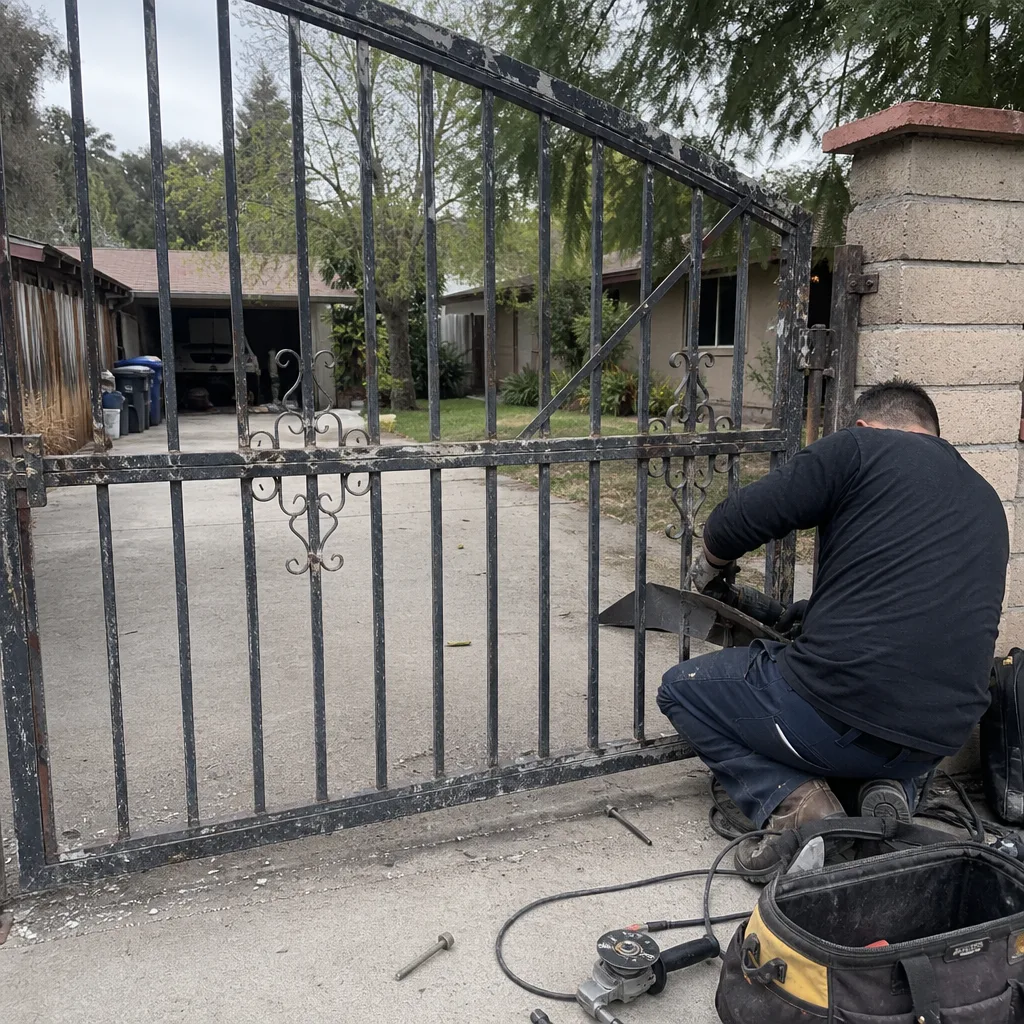 Before
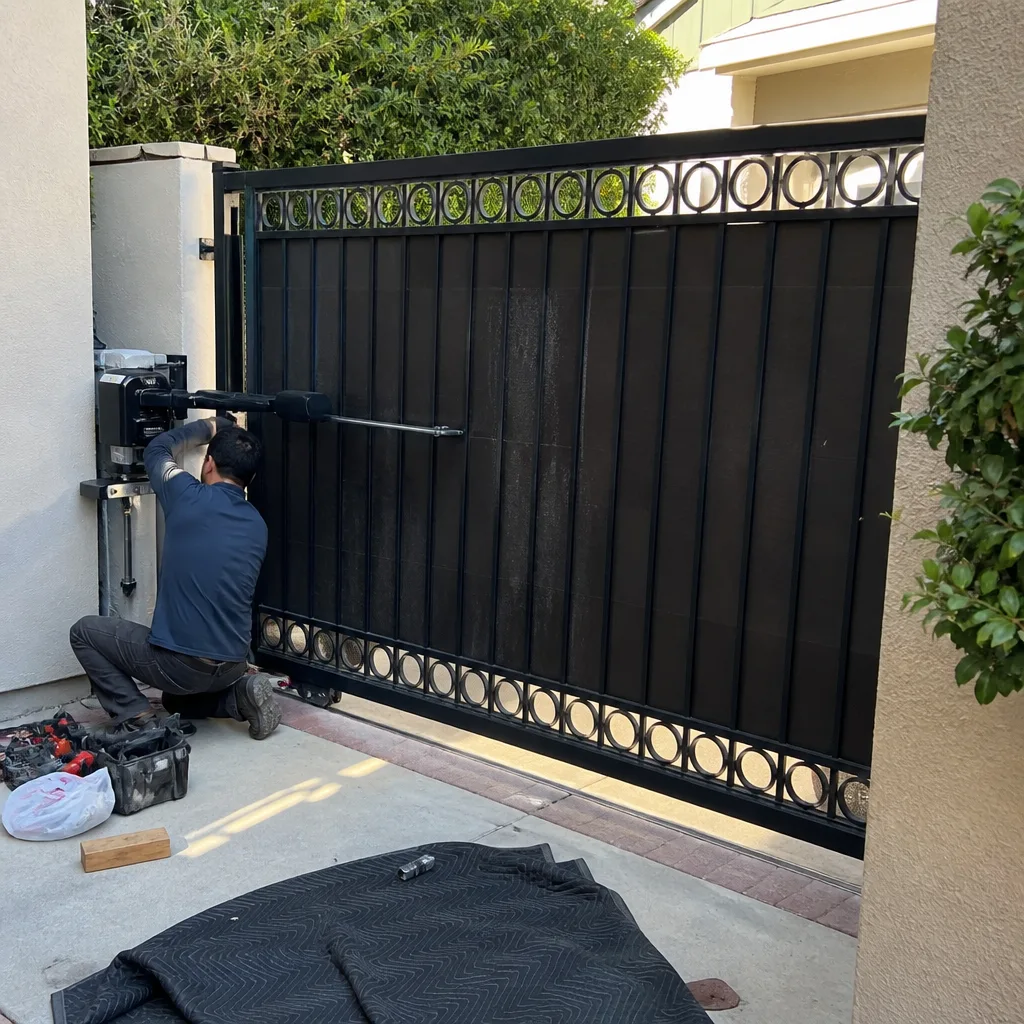 After
After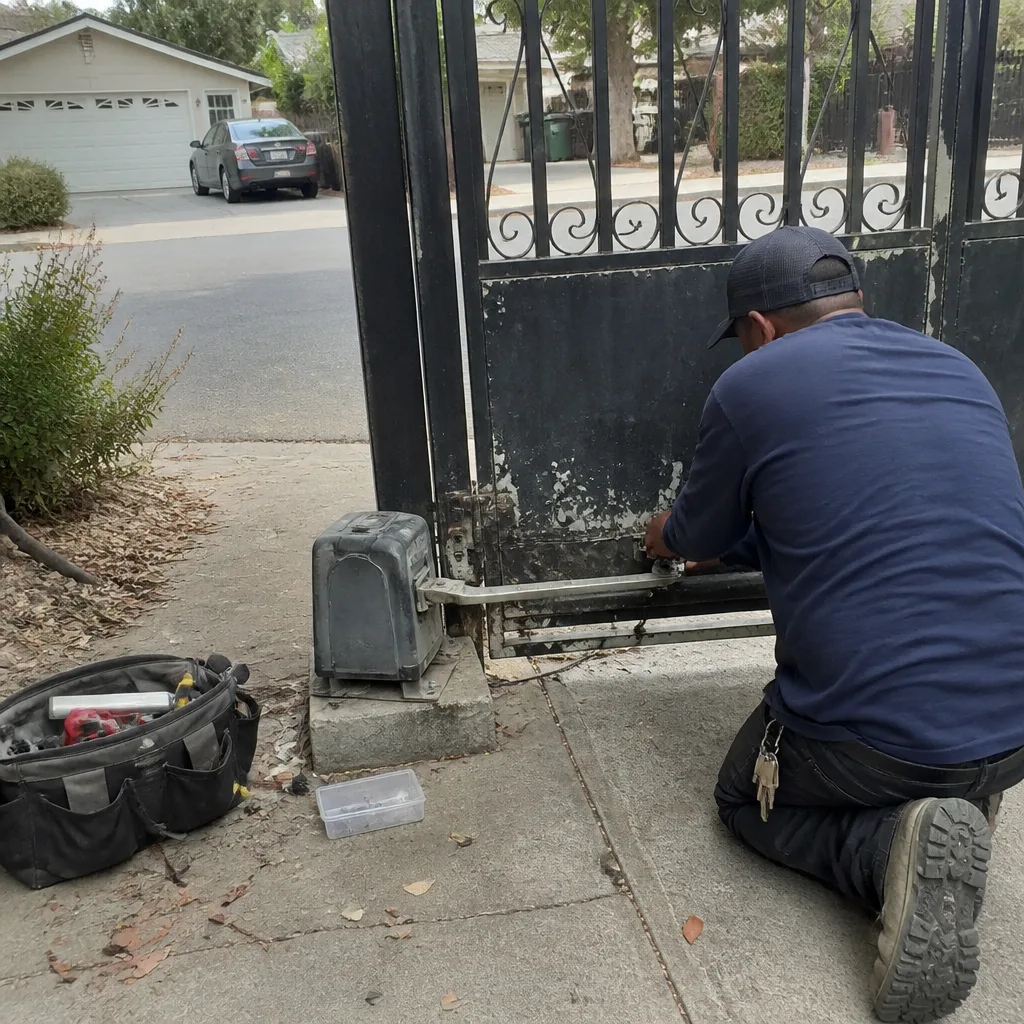 Before
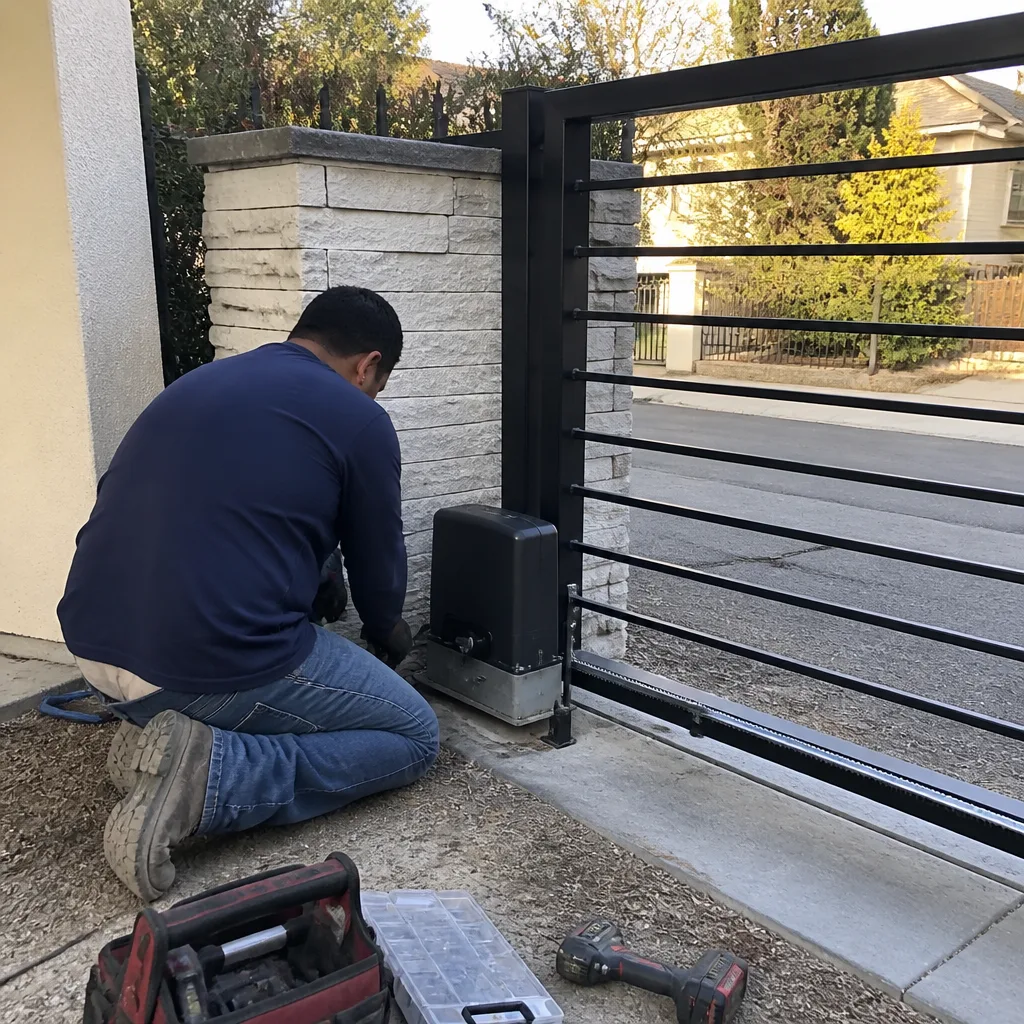 After
After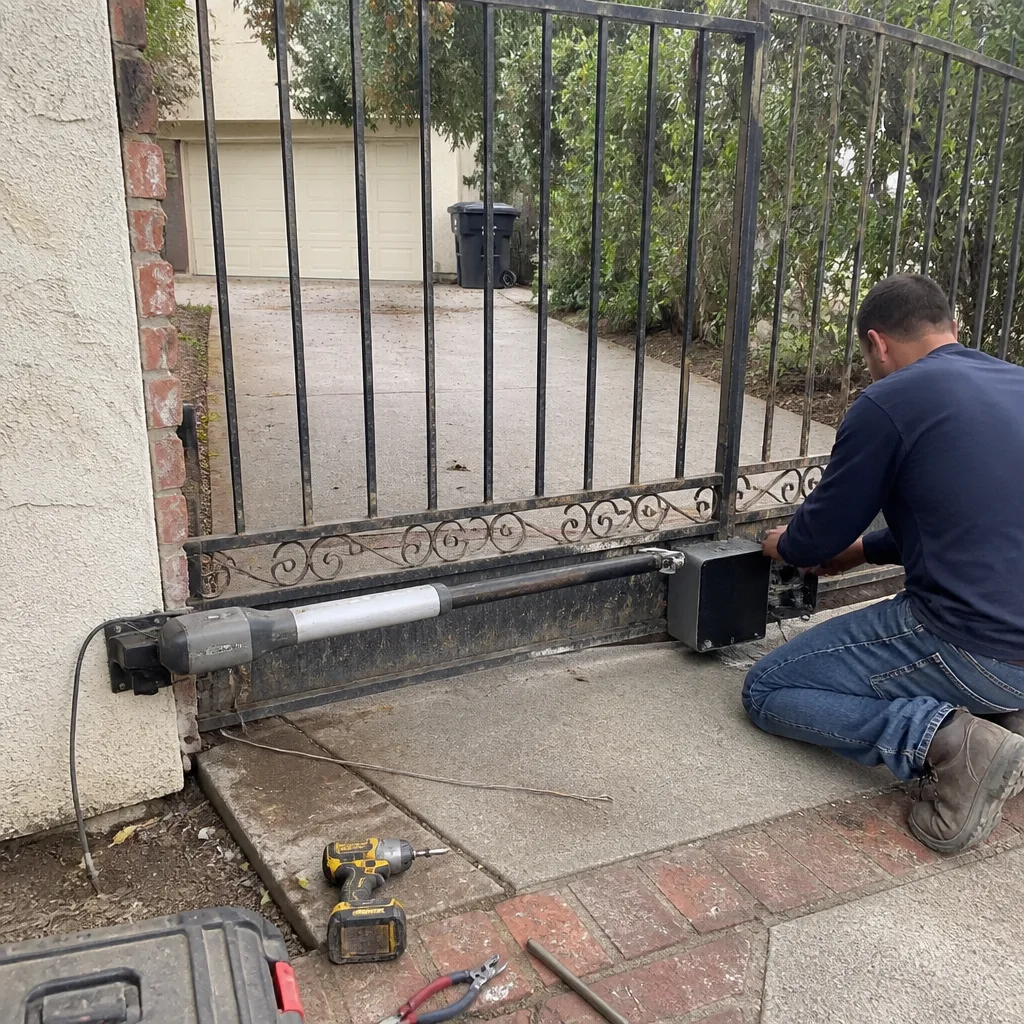 Before
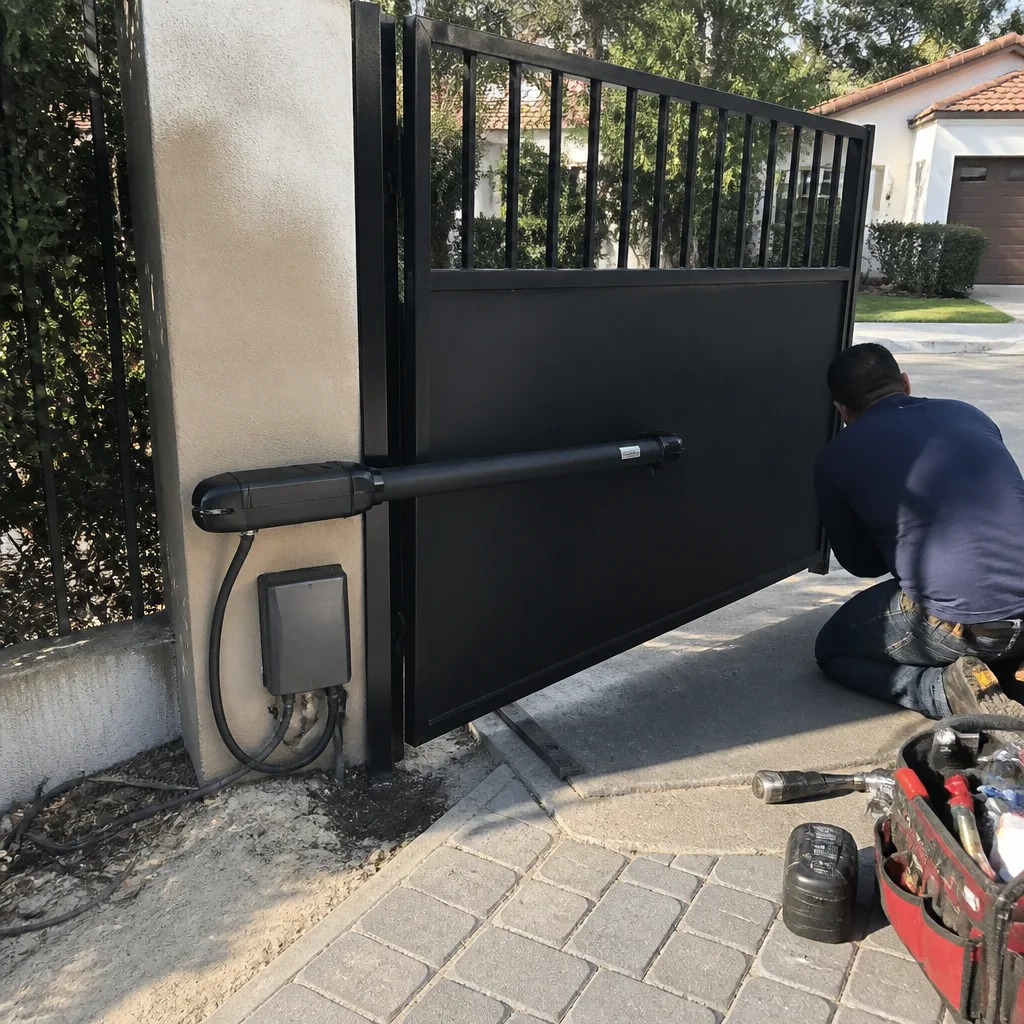 After
AfterSeasonal Gate Repair Care for Tarzana: Year-Round Homeowner’s Guide
Most Tarzana homeowners replace a gate motor twice as often as they should. The failures we see week after week are rarely the motor’s fault. They are the result of small, seasonal problems left unattended: a hinge that bound up in February, a safety edge that baked brittle in August, a photo eye that spent six months aimed at a growing bougainvillea. This guide explains what the San Fernando Valley’s seasons actually do to a driveway gate, what to check each quarter, what you can handle yourself, and what deserves a trained hand. We have repaired and rebuilt gates in Tarzana for decades, and the pattern holds: the homeowners who spend twenty minutes four times a year almost never see us for an emergency.
Quick Answer
Seasonal gate care in Tarzana comes down to four checks a year: lubricate hinges and wheels in spring and fall, confirm the auto-reverse and photo eyes work after every major temperature swing, clear the track and chain of debris before the Santa Ana winds arrive, and have a professional inspect the motor, limit switches, and safety edges once a year. A gate that is dry-lubed, aligned, and safety-tested seasonally will typically outlast one left alone by five to eight years. An $89 Seasonal Tune-Up once a year catches most problems before they strand you outside the gate.
Table of Contents
- What Tarzana’s Climate Does to a Gate
- Spring Gate Care: Recovering from Winter Rains
- Summer Gate Care: Heat, Sun, and Expanding Metal
- Fall Gate Care: Santa Ana Winds and Debris Load
- Winter Gate Care: Rain, Rust, and Cold Motors
- What a Seasonal Tune-Up Actually Includes
- Safety Checks Every Homeowner Should Do
- Brand-Specific Notes: LiftMaster, DoorKing, and Others
- Common Mistakes to Avoid
- When to Call a Professional
- Frequently Asked Questions
- The Bottom Line
What Tarzana’s Climate Does to a Gate
Tarzana sits in the southwestern San Fernando Valley, which means three things for any iron or steel gate: intense summer heat that regularly pushes past 100 degrees, winter rain that arrives in short but heavy bursts, and Santa Ana winds that carry dust, leaves, and grit into every moving part. A gate on Corbin Avenue ages differently than a gate in Woodland Hills two miles west. The combination of valley heat and wind-blown debris is the defining challenge.
Metal expands when it is hot. A black iron gate in full afternoon sun on a Tarzana summer day can reach 160 degrees at the surface. Hinges that fit snugly at 70 degrees bind at 100. Motors work harder. Circuit boards inside the operator housing bake. Over the course of one summer, that heat stress is minor. Over five or ten summers, it compounds: solder joints fatigue, capacitors dry out, gear grease thins and runs out of the gearbox. A gate that worked fine for fifteen years does not fail suddenly in July. It fails in July because fifteen Julys have been slowly wearing it down.
Winter brings the opposite problem. Rain introduces moisture into hinge pins, wheel bearings, and chain links. Rust forms where paint has chipped. Then the Santa Anas return in fall and winter, blowing sand and leaf litter directly into tracks, chains, and photo-eye lenses. This is not a theoretical issue. We have pulled eucalyptus leaves out of gate tracks on Reseda Boulevard every October for years. The pattern in Tarzana is specific and predictable, which means the maintenance is specific and predictable too.
Our Ironworks Gate Co. home service area covers the full range of Tarzana neighborhoods, from the flats south of Ventura Boulevard to the hills north of the 101, where gate wear accelerates because of steeper driveways and stronger winds.
Spring Gate Care: Recovering from Winter Rains
By March, Tarzana’s winter rains have done their work. Hinge pins have absorbed moisture. Wheel axles have taken on water. If the gate is chain-driven, the chain has collected road grit that mixed with rain into a grinding paste. Spring maintenance is about cleaning that out and preparing the gate for the dry heat to come.
Here is a spring checklist that takes a homeowner about twenty minutes:
- Inspect every hinge. Look for rust streaking down from the pin. If you see orange staining, the pin has begun to rust internally. Wipe it down and apply a dry lubricant. Do not use WD-40; it is a solvent, not a lubricant, and it will strip away whatever grease remains.
- Clean the track. For sliding gates, use a blower or a stiff brush to clear the track of leaves, dirt, and small stones. Debris in the track forces the gate motor to work harder and accelerates wear on the drive wheels.
- Check wheel bearings. Cantilever and V-track gates ride on wheels. Spin each wheel by hand with the gate in manual mode. A wheel that grinds or wobbles is nearing failure and should be replaced before it digs a groove into the track.
- Test the auto-reverse. Place a 2×4 or a filled trash can in the gate’s path and close it. The gate should stop and reverse on contact. If it does not, the clutch or the safety system needs adjustment. This is the most important safety test on the list.
- Re-tension the chain. Chain-driven gates stretch over time. A chain that sags more than an inch in the middle needs tensioning. A loose chain will eventually jump the sprocket and jam the gate.
In Tarzana specifically, spring is also when jasmine and bougainvillea begin their aggressive growth. Anything planted within three feet of the gate path will grow into the photo-eye’s line of sight by May. Trim it back now, and you will save yourself a gate that refuses to close in June because a vine is blocking the sensor.
Summer Gate Care: Heat, Sun, and Expanding Metal
Tarzana summers routinely deliver strings of 100-degree days. The gate track, the hinges, and the metal itself all expand. A gate that operated smoothly in April can start binding in July because the clearances were set too tight for thermal expansion. This is the season when we see the most motor burnouts and the most control-board failures.
The first heat wave of the year is the most instructive. During that first 100-degree week, run the gate through a full open-and-close cycle while you listen. A motor that has changed pitch, a gate that hesitates mid-travel, a limit switch that stops the gate an inch short of where it used to stop: all of these are heat-related signs. Address them early. A motor that strains against a binding hinge for a full summer will be a dead motor by September.
Summer checklist for Tarzana:
- Listen for new sounds. Grinding, squealing, or a heavy laboring sound means the motor is fighting something. It will lose that fight eventually.
- Check the operator housing temperature. After the gate has run a few cycles on a hot afternoon, place a hand on the motor housing. It will be warm. It should not be too hot to touch. An overheating motor is often a motor with failing capacitors or a control board working beyond its rating.
- Inspect the safety edges. Rubber safety edges dry out and crack in sustained heat. A cracked edge loses its sensitivity and may not reverse the gate when it contacts a car bumper or a child. Replace edges that show visible cracks or feel stiff and brittle.
- Lubricate early in the morning. Apply dry lubricant to hinges and bearings before the day heats up. Lubricant applied at 7 a.m. penetrates better than lubricant applied at 3 p.m.
One Tarzana-specific note: the valley’s summer smog and dust settle on gate surfaces. Every few weeks in August and September, wipe down the photo-eye lenses with a dry cloth. Dust film on a lens reduces its range and can cause intermittent failures that are maddening to diagnose. A fingerprint-sized smudge on a photo eye in the Melvin Avenue corridor can turn into a gate that opens fine but refuses to close after sunset.
Fall Gate Care: Santa Ana Winds and Debris Load
October in Tarzana means Santa Ana winds. Dry, sustained, and typically arriving from the northeast, these winds push leaves, palm fronds, and fine dust into every gap in a gate system. A gate that lives on a street with mature trees will collect more debris in October and November than in the other ten months combined.
Before the first major wind event of the season, do the following:
- Clear the full track length. Do not just clear the visible section. Walk the entire track, including the portion hidden behind shrubs or behind the gate in the open position. A palm frond lodged at the far end of the track will stop a sliding gate cold.
- Secure loose hardware. Wind-driven vibration loosens bolts over a season. Check the bolts on the gate hinges, the motor mount, and the track brackets. A quarter-turn on each bolt now prevents a sagging gate in December.
- Check the chain or belt tension. Same principle as spring, but the test matters more now because a loose chain in windy conditions slaps and wears against its guides.
- Test the manual release. Make sure you can open the gate by hand if the power goes out. Santa Ana winds cause power outages. You should know how to release the operator and push the gate open without calling anyone.
- Trim branches. Anything that can break off in a wind gust and fall on the gate, the track, or the motor needs to come down. A branch on the track is an inconvenience. A branch that knocks the photo eye out of alignment is a service call.
Fall is also the right time to schedule a professional seasonal tune-up. We perform hundreds of these each year in Tarzana, and the pattern is consistent: the gates that get a fall tune-up go through the winter without a single failure. The gates that do not are the ones we are pulling apart in January with rusted bearings and burned-out limit switches.
Winter Gate Care: Rain, Rust, and Cold Motors
Tarzana winters are mild by national standards, but the rain is real, and it arrives in concentrated bursts. Two or three inches in a day is common during atmospheric river events. For a gate, the problem is not the rain itself. It is the water that gets into hinge pins, wheel bearings, and chain housings and then sits there.
Standing water inside a hinge pin creates rust. Rust is abrasive. Every time the gate cycles, that rust grinds against the pin. Over a winter, a hinge that was quiet in November starts creaking in February. By March it has worn oval. Worn hinges transfer load to the motor, and the motor’s lifespan shortens accordingly. This is a slow cascade, and it is entirely preventable.
Winter maintenance for Tarzana homeowners:
- After every major rain, cycle the gate and listen. Creaking is the first sign of water intrusion. Address it while it is a creak, not a grind.
- Inspect the bottom seal. If your gate has a bottom rubber seal, confirm it is intact. A missing seal allows water to splash up into the lower track and wheel housings.
- Check the operator housing for moisture. Open the cover on a dry day and look for condensation. Condensation inside the housing drips onto the control board and the transformer. A corroded control board is a common winter failure.
- Run the gate manually once a month. This works the grease through the gearbox and keeps bearings from seizing in place. A gate that sits closed all winter will often refuse to open in the spring.
One thing we tell Tarzana homeowners every winter: do not pressure-wash your gate in January to get the rain streaks off. Blasting water into hinge joints and bearing housings pushes water deeper into places it cannot drain from. A bucket of soapy water, a soft brush, and a garden hose at low pressure are all you need. Save the pressure washer for the driveway.
What a Seasonal Tune-Up Actually Includes
An $89 seasonal tune-up sounds like a minor service, and for a reputable company it is exactly what the name says: a thorough inspection and adjustment. For a gate, the value is not in the labor. It is in catching a $40 bearing before it becomes a $900 motor replacement. Here is what a proper tune-up should cover, in the order we perform it.
- Full mechanical inspection. Hinges, wheels, track, chain or belt, and all mounting brackets are checked for wear, looseness, and alignment.
- Motor and gearbox evaluation. The operator is opened, inspected for moisture and corrosion, and run through test cycles while we listen for laboring or unusual sounds.
- Safety system testing. Photo eyes, safety edges, and auto-reverse are tested under load. This is the part most homeowners skip, and it is the part that matters most.
- Lubrication. Dry lubricant applied to hinges, bearings, and chain. Not grease, which attracts dust and grit in Tarzana’s dry climate.
- Limit switch adjustment. The gate should stop exactly where it is supposed to stop. A gate that over-travels stresses the hinge welds and the motor.
- Battery backup check. If your gate has a battery backup, it gets load-tested. A battery backup that has not been tested in three years is a battery backup that will not work when the power goes out.
- Written report. You should leave the tune-up knowing exactly what was checked, what was adjusted, and what may need attention in the next twelve months. If a company cannot give you a written report, find another company.
We perform tune-ups on every major gate brand, and the process does not change much between them. What changes is the specifics: a DoorKing operator has different limit switch architecture than a LiftMaster, and an Elite slide gate wears differently than a swing gate from the same manufacturer. The point is that the person doing the tune-up should know the difference. Most problems we find during tune-ups in Tarzana are brand-specific issues that a generalist would have missed.
Safety Checks Every Homeowner Should Do
A driveway gate is the heaviest moving object on most Tarzana properties. A 16-foot iron swing gate can weigh 800 pounds or more. When that gate is automated, it has the force of a small vehicle behind it. The safety systems built into gate operators are there to prevent serious injury. They only work if they are tested and maintained.
Three safety tests every homeowner should perform monthly:
- The auto-reverse test. Place a rigid object, a 2×4 works well, in the gate’s path and close the gate onto it. The gate must stop and reverse within two seconds of contact. If it pushes through the obstruction, the clutch is out of adjustment. Do not use a child or a pet to test this. Use something that will not be damaged or injured.
- The photo-eye test. With the gate closing, pass your hand through the photo-eye beam. The gate should stop immediately and reverse. If nothing happens, the photo eye is misaligned, dirty, or dead. Clean the lenses first. If the problem persists, call a professional.
- The manual release test. Pull the manual release on the operator and confirm you can push the gate open by hand. You need to know this works before an emergency, not during one.
A note on safety edges: rubber safety edges on the leading edge of the gate degrade slowly. A homeowner cannot easily test one without the right equipment. During a seasonal tune-up, we test safety edges with a pressure gauge. An edge that does not register within its specified pressure range gets replaced on the spot. In Tarzana’s summers, we recommend testing edges at least twice a year because heat aging changes their sensitivity faster than you might expect.
Never attempt to adjust the clutch, the force settings, or the limit switches on a gate operator yourself. The springs and the motor are under tension, and a misadjusted gate can crush a person or a vehicle. A wrong adjustment made in five minutes costs more to correct than a service call. This is safety equipment, and it deserves the same respect you would give a garage door spring or a breaker panel.
Brand-Specific Notes: LiftMaster, DoorKing, and Others
In Tarzana, we see a mix of operator brands on the driveways. The older homes south of Ventura Boulevard often still run DoorKing and Elite operators installed decades ago. The newer hillside homes tend toward LiftMaster and Mighty Mule. Each brand has seasonal failure patterns worth knowing.
LiftMaster operators are rugged and generally dependable in valley heat, but the control boards are sensitive to moisture. Condensation inside the housing during winter rain events is the leading cause of LiftMaster failures in Tarzana. If your LiftMaster works fine all summer and starts acting erratically in January, moisture is the likely culprit. The fix is usually a control board replacement and a re-sealed housing, not a new motor.
DoorKing operators are built like tanks and can run for decades, but their limit switches wear mechanically over time. A DoorKing gate that begins stopping short or over-traveling is telling you the limit switch assembly needs attention. In our experience, DoorKing gates in Tarzana that receive annual limit switch adjustments routinely reach twenty-plus years of service. The ones that get ignored start eating gears instead.
Elite slide gates are common on Tarzana properties with long driveways, and they are generally well-suited to the climate. The weak point is the chain tension. Elite chains stretch predictably in high-heat environments, and a loose chain on an Elite slide gate wears the drive sprocket quickly. Checking chain tension in spring and fall prevents most Elite failures we see.
Whatever brand sits on your driveway, the seasonal maintenance rhythm does not change: inspect, lubricate, test the safety systems, adjust what needs adjusting. The brand only changes what to look for during the inspection.
Common Mistakes to Avoid
- Using grease instead of dry lubricant. Grease holds dirt. In Tarzana’s dry, dusty climate, greased hinges become grinding paste within a month. Use a dry PTFE or silicone lubricant on hinges and bearings.
- Ignoring a slow gate. A gate that opens slower than it used to is telling you the motor is struggling. The cause is usually mechanical, not electrical: a binding hinge, a dirty track, or a failing bearing. Fix the cause and the speed returns.
- Pressure-washing the gate and operator. This forces water into hinges, bearings, and the motor housing. After a pressure-wash, the gate often works fine until the corrosion sets in three months later.
- Testing the auto-reverse with a car in the gate’s path. A car bumper is not a reliable test. By the time the gate contacts a car, the force has already been absorbed by the vehicle. Use a rigid object and watch what happens. Better yet, call for a tune-up where the force settings are tested properly.
- Letting landscaping grow around the photo eyes. In Tarzana, bougainvillea and jasmine can overtake a photo-eye path in a single growing season. The result is a gate that opens but will not close, which is the most common complaint we hear from homeowners between May and September.
- Skipping the manual release check. The manual release only matters during a power outage, and power outages in Tarzana tend to happen during Santa Ana wind events when the gate is most needed. Check it monthly.
- Buying the cheapest replacement part online. A $12 aftermarket limit switch for a $400 operator typically lasts six months and fails at the worst possible time. Use manufacturer parts or equivalent-quality components from a supplier that stands behind them.
When to Call a Professional
Some gate work is genuinely dangerous, and some is simply not worth the cost of a wrong guess. If your gate has stopped working entirely and you cannot identify the cause within five minutes, stop. A gate that will not open with the manual release engaged needs a professional. A gate that reverses randomly, opens on its own, or closes on objects without reversing is a safety hazard that requires immediate professional attention. Any problem with the motor, the control board, or the force settings is not a DIY project.
Ironworks Gate Co. offers free estimates in Tarzana. Call (925) 263-6107. We will tell you what is wrong, what it costs to fix, and whether it can wait. No pressure, no obligation.
Frequently Asked Questions
Gate repair in Tarzana typically runs $180 to $450 for common issues like limit switch adjustments, hinge replacements, and photo-eye repairs, while a full motor replacement runs $800 to $2,200 depending on the operator brand and driveway configuration. We quote the exact price before any work begins. Call (925) 263-6107 for a free estimate.
Once a year is the minimum for a gate in Tarzana, and twice a year is better if your gate faces direct sun or sits under mature trees. The $89 seasonal tune-up we offer covers the full inspection, lubrication, and safety testing described above, and most customers do it once in the fall before winds and rain arrive.
Most gate repairs in Tarzana are completed in a single visit, and we prioritize safety issues like a gate that will not close or reverses unpredictably. A live person answers the phone 24 hours a day, 7 days a week, so if your gate is stuck open at 9 p.m., you will not get a voicemail.
Nine times out of ten in Tarzana, a gate that opens but will not close has an obstruction in the photo-eye path: a vine, a trash can, or a car parked too close. Clear the area and wipe the photo-eye lenses. If the problem continues, the photo eye is misaligned or dead, which is a quick fix for a technician.
We service nine major gate-automation brands including LiftMaster, DoorKing, Elite, and Mighty Mule, along with FAAC, BFT, Linear, Viking, and Ghost Controls. If your operator is from a brand not on that list, call us anyway. The mechanical systems underneath are similar, and we will tell you honestly if it is worth repairing.
Yes. The purpose of a tune-up is not to fix a broken gate: it is to prevent a working gate from breaking. Most motor failures and limit-switch replacements we do in Tarzana could have been avoided with a $12 bearing or a $20 sensor caught during a tune-up. We will also give you a written report of what was checked and what may be coming due.
The Bottom Line
A gate in Tarzana lives with heat, dust, wind, and rain, and it will outlast the driveway it sits on if it gets four honest checks a year: spring cleaning after the rains, summer attention to heat stress, fall preparation for Santa Ana debris, and winter protection from moisture. The safety systems deserve monthly testing. The mechanicals deserve annual professional eyes. Spend a little time on the gate each season, and it will do its quiet job for decades. Ignore it, and it will choose the worst possible moment to fail. The choice is yours, and if you would rather not make the checks yourself, our $89 seasonal tune-up handles all of it. Call (925) 263-6107 and we will take it from there.
Written by Victor Salinas, Owner at Ironworks Gate Co., serving Tarzana since 2013.