
Last updated August 25, 2026
Free on-site gate assessment - hinges, posts, and your LiftMaster or Nice gate operator checked before anything is quoted
The assessment is free and the quote is the invoice.
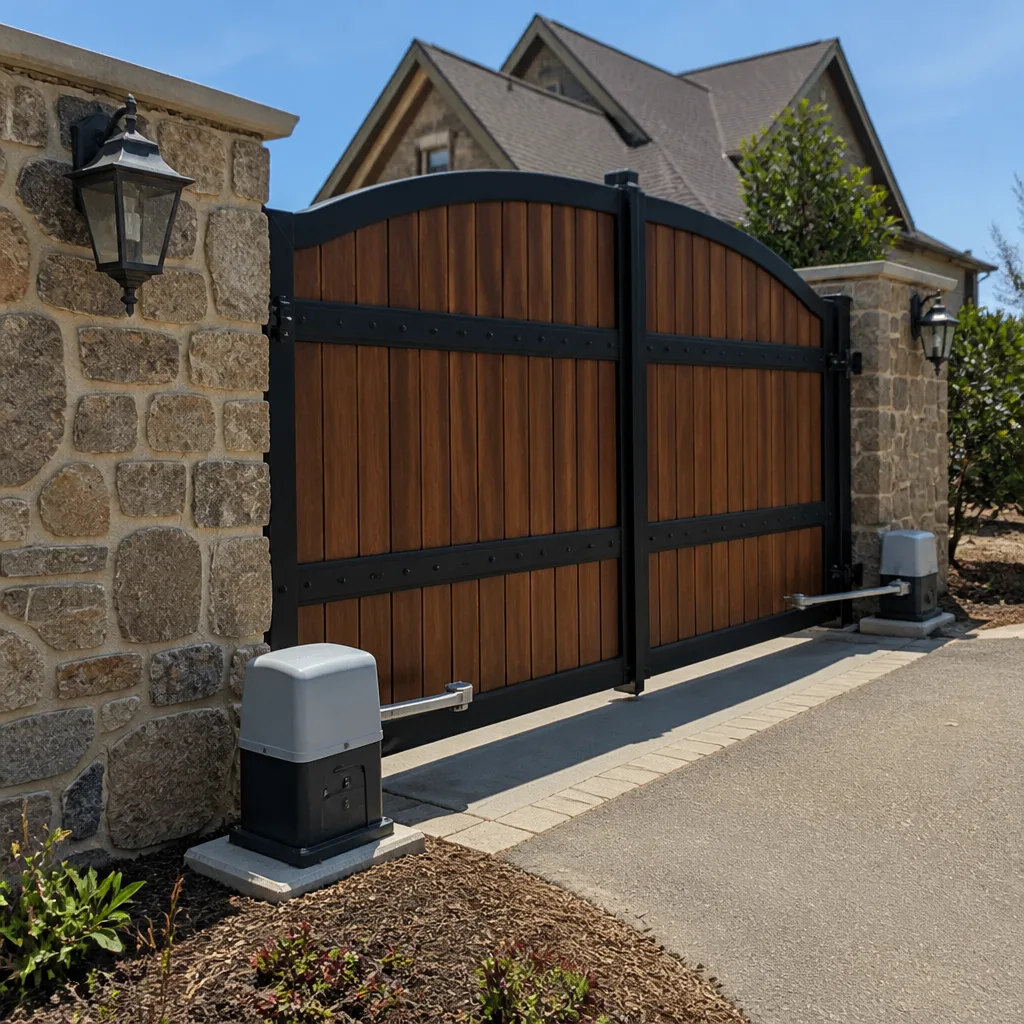
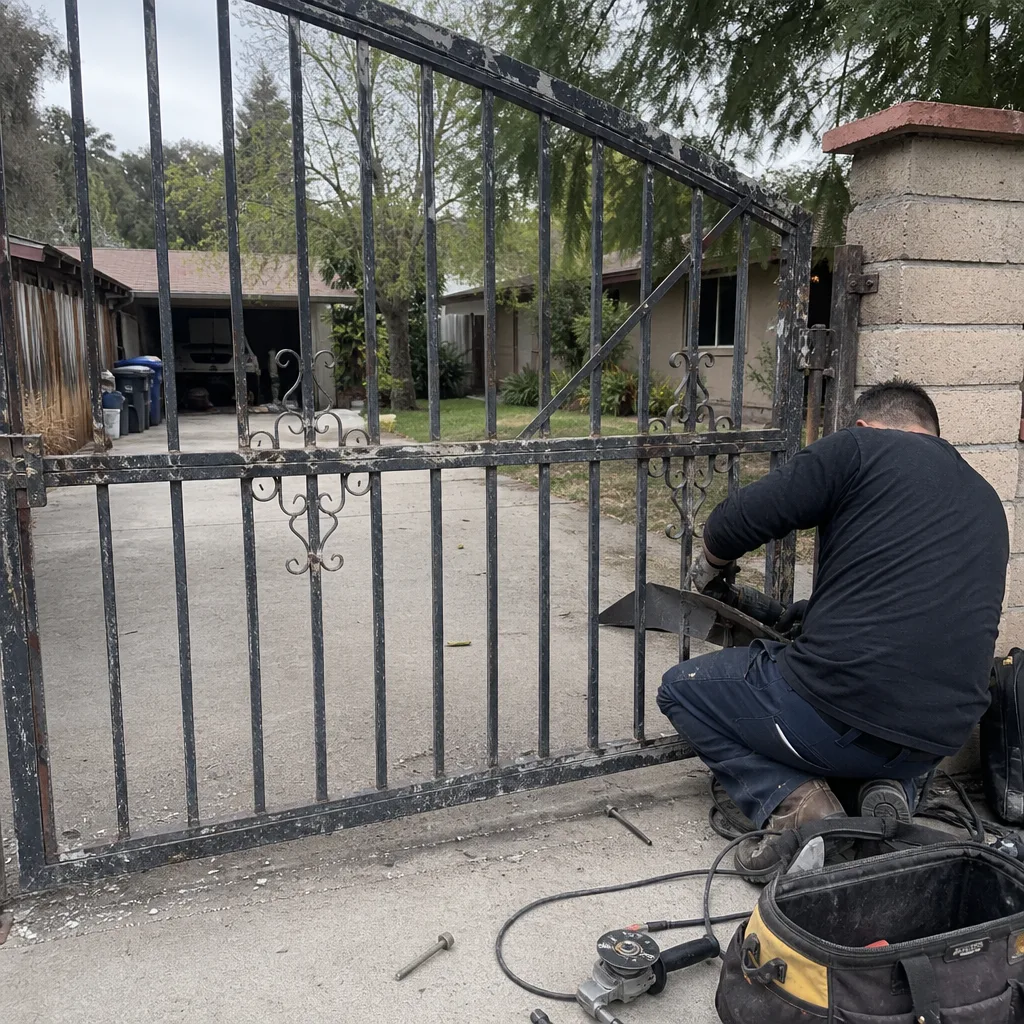 Before
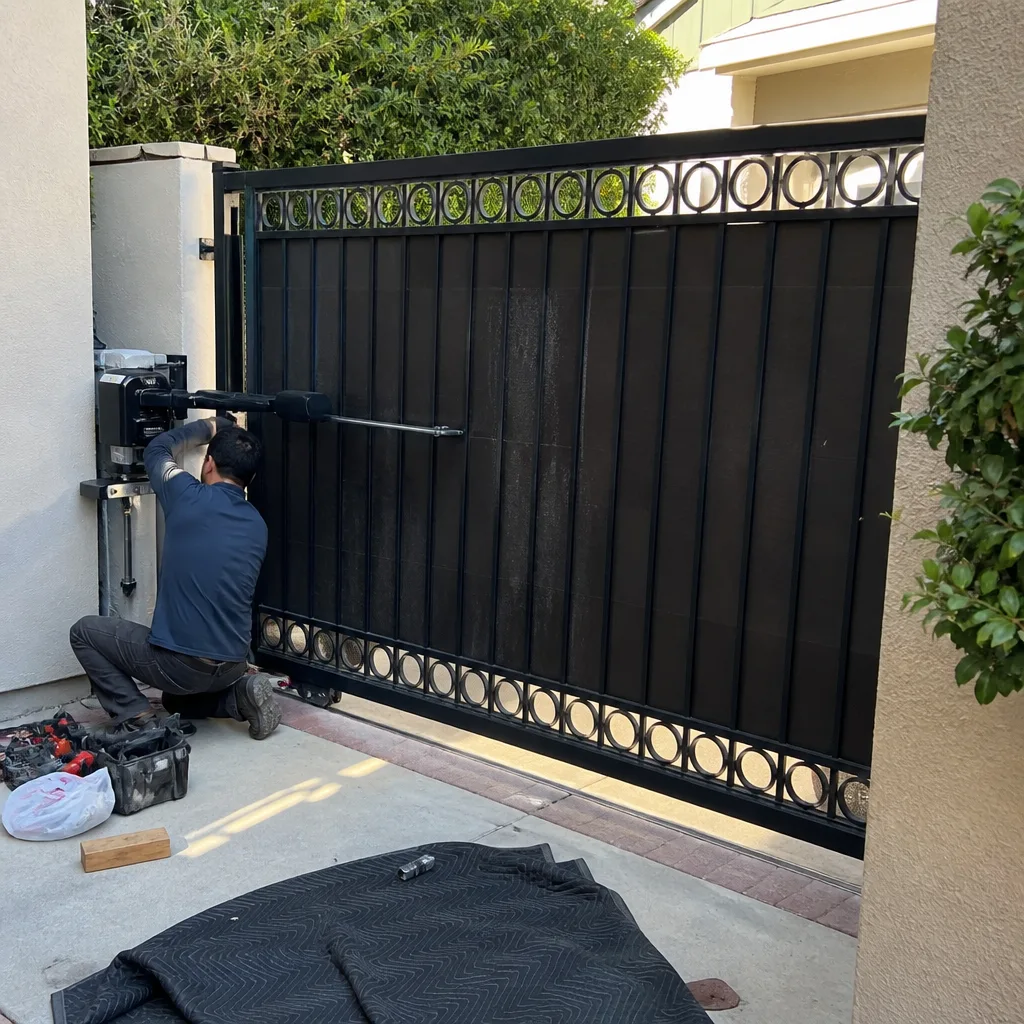 After
After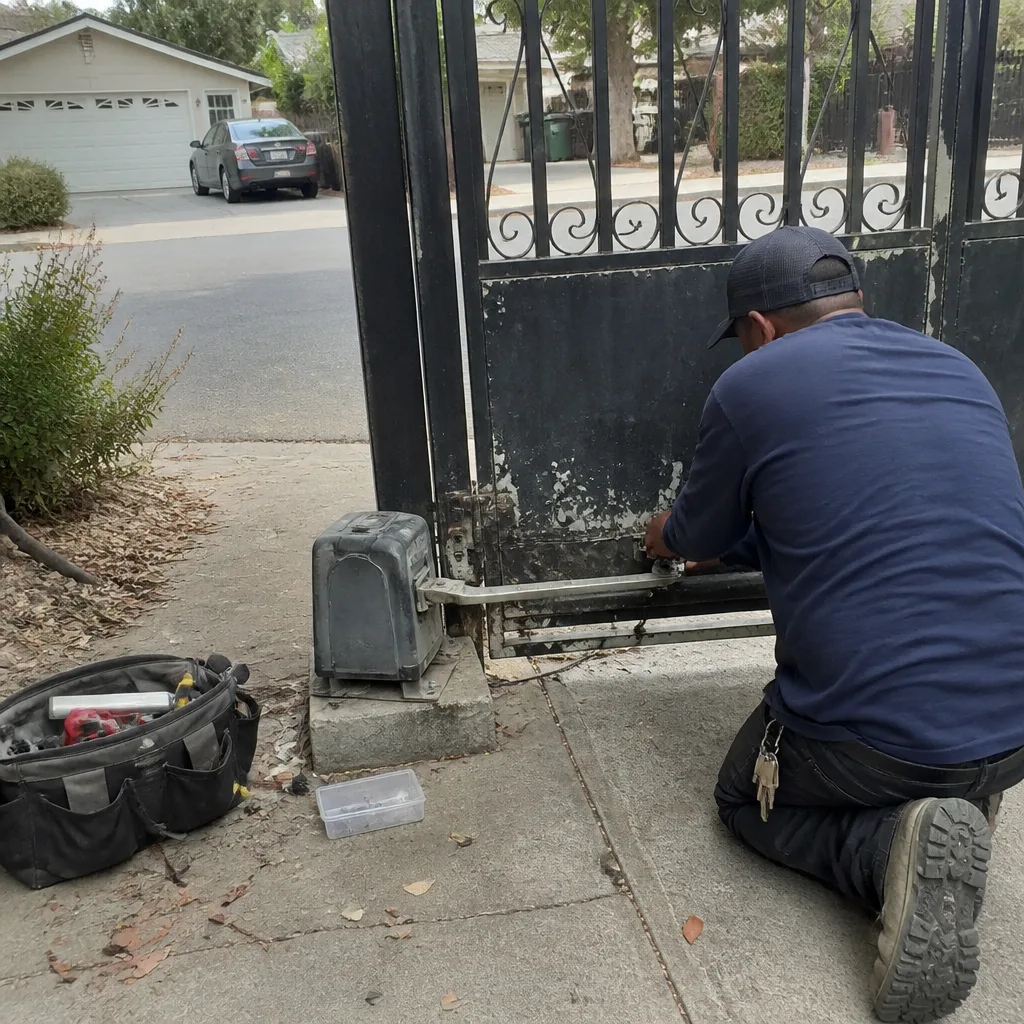 Before
 After
After Before
 After
AfterGate Repair Cost Breakdown: The Tarzana Homeowner’s Reference for 2026
Most Tarzana homeowners don’t budget for a gate failure until the morning the gate won’t open and the car is stuck in the driveway. That Tuesday-morning moment is when the questions start, and Google is not much help. The search results are full of national averages that have nothing to do with San Fernando Valley labor rates, parts availability for twenty-year-old openers, or the way Tarzana’s heat and dust shorten the life of a circuit board. This guide is the reference we wish every customer had before picking up the phone. You’ll learn what a repair should cost in this specific market, which failures are worth fixing versus replacing, what a fair invoice looks like line by line, and which red flags separate a shop that stands behind its work from one that disappears after cashing the check. If you own an automatic driveway gate in Tarzana, the numbers below are the numbers that matter.
Quick Answer
Gate repair in Tarzana typically costs between $185 and $1,450 depending on what failed. A hinge or wheel repair on a manual gate runs $185 to $400. An opener control board replacement runs $450 to $900. A full operator replacement on a double swing gate runs $1,200 to $2,500 installed. The most common repair we see in Tarzana, a failed circuit board from heat and power surges, lands right around $500 to $750 parts and labor.
Table of Contents
- What a Gate Repair Actually Costs in Tarzana, Line by Line
- The Single Biggest Factor That Moves the Price
- Repair vs. Replace: How to Know Which One You’re Buying
- Why Tarzana’s Climate Wears Out Gate Parts Faster
- What a Fair Invoice Looks Like, Step by Step
- The Questions to Ask Before You Approve Any Work
- Common Mistakes to Avoid
- When to Call a Professional
- Frequently Asked Questions
- The Bottom Line
What a Gate Repair Actually Costs in Tarzana, Line by Line
Let’s talk real numbers, because the national averages you’ll find elsewhere include markets where labor is half what it is in Los Angeles County. In Tarzana, you’re paying San Fernando Valley labor rates. A qualified gate technician bills between $95 and $145 an hour, and most repairs take one to three hours on site. The rest of the invoice is parts, and parts vary enormously depending on what’s on your driveway.
Here’s the breakdown we give homeowners when they call for a price ballpark over the phone:
- Manual gate hinge replacement: $185 to $400. The hinges themselves run $35 to $90 each for galvanized or powder-coated steel, and labor is usually one to two hours. If the post is rotted or the gate has sagged enough to need re-hanging, add $150 to $250.
- Weld repair on a steel gate: $250 to $700. A cracked weld at a hinge point or mid-rail is a two-hour job with a mobile welder, plus grinding and repainting. We’ve seen gates in Tarzana’s older neighborhoods, the ones built in the 1960s and 1970s south of Ventura Boulevard, where the original welds held for fifty years before finally giving out.
- Opener control board replacement: $450 to $900. The board itself runs $200 to $450 depending on brand. A LiftMaster board is more expensive than a generic aftermarket, but it’s also the difference between a repair that lasts ten years and one that fails in eighteen months.
- Limit switch or sensor replacement: $150 to $350. Parts are cheap, but getting the travel limits recalibrated correctly takes time. This is the most commonly misdiagnosed repair in our industry, and the reason second opinions exist.
- Safety edge or photo eye replacement: $200 to $400 per component. Tarzana is a city of kids on bikes and dogs in driveways, and a functional safety edge is a non-negotiable.
- Full operator replacement, single swing gate: $1,200 to $2,200 installed. That’s the motor, arm, new hardware, and labor. A double swing adds $300 to $600 depending on whether both leaves need operators or just one.
- Sliding gate motor replacement: $1,400 to $2,500 installed. Cantilever sliding gates, common on the wider lots north of the Boulevard, use heavier motors and more involved rack work.
- Track and roller replacement on a sliding gate: $400 to $900. The V-track and guide rollers in Tarzana take a beating from the dry, gritty soil. Once the track is worn unevenly, the gate starts jumping rollers and the motor strains, which shortens the motor’s life.
Every price above is quoted and agreed before a single bolt is turned. That’s how we work, and it’s the only way a repair invoice should ever be presented to you. If a company won’t give you a written number before starting, that’s your cue to call someone else.
The Single Biggest Factor That Moves the Price
It’s not the brand. It’s not the gate size. It’s whether the problem is mechanical or electronic, and most homeowners can’t tell the difference. Here’s a simple way to think about it.
A mechanical problem is something you can usually see or hear: a sagging gate, a squealing hinge, a wheel that’s jumped the track, a gate that grinds when it moves. These repairs are labor-driven, and the parts are relatively inexpensive steel and hardware. The cost is in the time a technician spends getting the geometry right, and that time is worth paying for. A gate that’s re-hung properly closes like it did the day it was installed.
An electronic problem is the opposite: the gate looks fine, but it won’t open, or it opens halfway, or it opens by itself at 3 a.m. The parts cost real money. Control boards, limit switches, receivers, and transformers are the expensive components, and diagnosing which one failed requires a meter and experience, not just a parts-swapping trip to the truck. In Tarzana, where power fluctuations and summer heat are facts of life, we see far more electronic failures than mechanical ones. The heat inside a metal control box on a 105-degree August afternoon can cook a circuit board in a single season.
The implication for your budget is simple. If the gate is making noise but still opening, breathe. That repair is probably under $400. If the gate is silent and dead, plan for the possibility of a $500 to $900 board replacement, and hope the technician who shows up knows how to actually test a board rather than guess.
Repair vs. Replace: How to Know Which One You’re Buying
We tell our Tarzana customers the same thing we’d tell our own mothers: when the repair cost exceeds half the cost of replacement, replace it. There’s no hard industry rule, but that’s the honest math.
Here’s step-by-step how we evaluate that decision on every call. This is the exact process we use, and it’s a fair one you can apply yourself before anyone arrives:
- Age of the operator. Gate openers in Tarzana last 10 to 15 years on average under residential use. If yours is past year 12, every dollar spent repairing it is a dollar you won’t get back. The useful life left in the unit is minimal, and the next component failure is not far behind. A twenty-year-old DoorKing or Elite that’s been through fifteen San Fernando Valley summers is not a unit to invest in.
- Cost of the part. A failed board on a current-model LiftMaster is a $500 repair on a $1,400 unit. That’s worth doing. A failed board, a worn gear, and a rusted arm on a discontinued Mighty Mule is a different story. The math changes when the repair starts stacking up.
- Availability. Some older models have parts that are no longer manufactured. Technicians can sometimes source used parts, but a used board is a gamble. We won’t install a used control board and call it a repair. It’s not right, and it won’t last.
- Overall condition of the gate itself. A $900 repair on an opener makes sense if the gate structure is solid and will last another twenty years. It makes no sense on a gate that’s rusting through, sagging, and due for structural work next year anyway. In those cases, the honest recommendation is to address the gate and the operator together, or at least plan for it.
- Safety concerns. If the safety edge or photo eyes have failed and your household includes children or pets, this is not a repair to defer while you think about the budget. A gate that doesn’t reverse on contact is a liability in a neighborhood like Tarzana, where driveways back up to sidewalks with real foot traffic.
We’ve replaced openers in Tarzana that were installed when the house was built in 1987, and we’ve repaired openers that were installed last year under warranty. Both are the right call in the right context. The trick is knowing which context you’re in, and a reputable company will tell you the truth even when the truth is that you should spend less, not more.
Why Tarzana’s Climate Wears Out Gate Parts Faster
The San Fernando Valley is hard on gate hardware in ways that coastal Los Angeles is not. If you’ve lived in Tarzana for more than a few years, you already know this from your car battery, your roof, and your air conditioner. Your gate is on the same schedule, and understanding why will save you money.
The summer heat is the first culprit. Temperatures in Tarzana reliably hit the high 90s from July through September, with stretches over 100 degrees. The control box on your gate opener sits in direct sun for hours, and the temperature inside that metal enclosure soars. Circuit boards are rated for operating ranges that the inside of that box exceeds on the worst days. Over enough summers, the solder joints fatigue and the capacitors bulge. This is the single most common failure we see in Tarzana, and it happens to every brand, including the good ones like LiftMaster and DoorKing.
The second culprit is dust. The Valley’s dry, gritty soil gets into everything. Limit switches gum up. Rollers wear. Track lubricants turn to abrasive paste. A gate that would run smoothly for a decade in Pacific Palisades needs more attention in Tarzana’s dirt, and that attention is cheaper when it’s a seasonal tune-up than when it’s a full track replacement.
The third factor is what we call the Santa Ana effect. Those dry wind events coat everything in a fine layer of dust and debris in a matter of hours. Photo eyes get obscured, triggering false obstructions. Keypads get grit behind the buttons. The fix for all of this is less about repair and more about prevention: a tune-up every 12 to 18 months that includes cleaning, lubrication, calibration, and a check of every electrical connection. It’s the cheapest gate money you’ll spend in Tarzana.
What a Fair Invoice Looks Like, Step by Step
Homeowners ask us all the time how to know if a quote is fair. The answer is that a fair invoice is transparent. It tells you what was done, what the parts cost, what the labor cost, and why. Here’s what we think every repair invoice should include, and what we’d want to see if we were hiring someone to work on our own driveway.
- A diagnosis, in writing, in plain English. “Control board replaced” is not a diagnosis. “Control board failed due to heat damage; relay for left leaf no longer energizing; replaced with OEM LiftMaster board, part number X, tested and calibrated” is a diagnosis. You’re paying for the technician’s knowledge. The invoice should show it.
- A clear split between parts and labor. Both should be listed with dollar amounts. If a company refuses to break them out, that’s a red flag. You have a right to know what the part cost and what the expertise cost.
- The agreed-upon price, signed before the work started. This is non-negotiable. The price you approve is the price you pay, period. If a company quotes $400 on the phone and hands you a $700 invoice, you’re being taken advantage of. In Tarzana, where word travels fast and reputation is everything, companies that do this don’t last. But that doesn’t help you if you’re the one holding the invoice.
- A warranty in writing. Every repair we do carries the 90-Day Done Right Promise. No paperwork to file, no arguing. If it’s not right, we come back and make it right. Every time, on every job. If a company won’t put a warranty on the invoice, don’t hire them.
- Notes on what was checked beyond the failure. A good technician walks the whole gate before leaving. Hinges, wheels, safety edges, photo eyes, keypad. If the invoice shows a 5-point or 10-point inspection, that’s the sign of a shop that does the job right, not a shop that swaps a part and drives away.
What does that add up to in Tarzana? A fair invoice for a typical opener board replacement might look like this: diagnosis $95, OEM control board $275, labor $225, total $595. You approve $595. That’s what you pay. That’s how it should be everywhere.
The Questions to Ask Before You Approve Any Work
These are the questions we’d tell a family member to ask any gate company, including us. A company that answers them comfortably is a company worth hiring. A company that hedges is a company to walk away from.
- “What exactly failed, and how do you know?” The answer should reference a specific test: voltage reading, continuity check, visual evidence. Not “these things just go bad.”
- “Is the price you’re quoting the price I’ll pay?” If the answer is anything other than a straight yes, hang up. The price is quoted and agreed before any work starts, and that’s the only way it works.
- “What’s the warranty, and is it in writing?” Verbal guarantees are worth the paper they’re not printed on. Every job we complete is protected by a written 90-Day Done Right Promise, and that’s the standard you should hold any company to.
- “Are you trained on my brand?” An opener is not an opener. We service nine automation brands including LiftMaster, DoorKing, Elite, and Mighty Mule, and the difference between trained and untrained on a specific brand is the difference between a correct fix and an expensive guess. Ask the question.
- “What else did you check while you were in there?” A technician who only looked at the part that failed isn’t earning the service call. The answer should include hinges, rollers, safety systems, and electrical connections.
- “Can you show me the problem before you fix it?” A reputable company will walk you to the gate and show you the failed component. We’ve always believed that a customer who sees the problem understands the invoice, and a customer who understands is a customer who trusts the work.
You’ll notice that none of these questions is “how fast can you get here?” Speed matters, but only when it’s paired with competence. A fast wrong diagnosis is still a wrong diagnosis, and you’ll pay twice.
Common Mistakes to Avoid
- Ignoring the first sign of trouble. A gate that closes hard, groans at the hinge, or needs a push to start is telling you something. Every week it runs in that condition, the repair gets more expensive. In Tarzana, where the heat accelerates wear, what starts as a $200 hinge repair becomes a $700 weld-and-rehang job by the time it fails completely.
- Buying the cheapest part instead of the right part. A generic aftermarket board might save $150 up front and cost you a second repair in eighteen months. On a brand like LiftMaster or DoorKing, OEM parts are engineered for the controller they’re sitting in. Cheap parts are the most expensive parts under a Tarzana summer.
- Hiring a generalist handyman for an electronics problem. The guy who fixed your fence is not the guy to diagnose a failed control board. Gate automation is a specialty, not a side job. The number of times we’ve been called in to fix a handyman’s gate repair in the Valley would surprise you, and the original repair is usually the most expensive part of the final invoice.
- Deferring safety-system repairs. A non-functioning safety edge or photo eye is not a cosmetic issue. It’s a UL 325 safety requirement, and it exists to protect your family and your neighbors. If a technician tells you it’s fine to skip, get a second opinion.
- Not asking for a written quote before the work starts. There is no legitimate reason a gate repair cannot be quoted up front. None. If a company wants to start working without a number, that’s the end of the conversation.
- Skipping the seasonal tune-up. A $89 tune-up once a year is the cheapest insurance policy on your driveway. In Tarzana’s heat and dust, it’s not optional maintenance. It’s the difference between a gate that fails on a random Tuesday and a gate that never fails at all.
- Choosing a company with no local footprint. Anyone can put “Tarzana” on a website. A company with 42 years in the Valley, a shop you can find, and a phone number where a live person answers at 2 a.m. is a company that has to stand behind its work. Reputation is a local check that the cheapest online search result can’t pass.
When to Call a Professional
Some jobs are obvious: the gate won’t open, the motor is dead, the hinge is broken. But there are quieter signals that a professional should see before they become emergencies. If the gate moves slower than it used to, or makes a sound it didn’t make last month, something is changing mechanically and ignoring it makes the repair worse. If the opener trips its breaker, or the gate reverses for no reason, or the keypad works when it feels like it, you have an electrical problem that will not fix itself. If the gate has sagged enough that it drags or the latch no longer lines up, the structure is out of square and hinge damage is compounding. And if you hear any grinding, popping, or metal-on-metal sound, stop running the gate and call someone. These are all moments where a professional in Tarzana should be looking at it this week, not next month. Ironworks Gate Co. offers free estimates in Tarzana, and we’ll tell you honestly if it’s a repair worth doing. Call (925) 263-6107.
Frequently Asked Questions
Most gate repairs in Tarzana run between $185 and $1,450, with the typical repair landing around $350 to $600. Simple hinge and wheel work sits at the low end, opener control board replacements sit in the middle, and full operator replacements reach the higher end. The price is always quoted and agreed before any work starts. Call (925) 263-6107 for an exact quote on your gate, and the estimate is free.
In most cases, yes. Most gate repairs are completed in a single visit, and we carry the common parts for DoorKing, LiftMaster, Elite, and Mighty Mule on our trucks. If your repair needs a part we don’t have in stock, we’ll tell you honestly and get it ordered, but most Tarzana homeowners have their gate running same-day when they call (925) 263-6107.
If the opener is under ten years old and the repair is a single component, repair it. If it’s over twelve years old, or it needs multiple components, replacement usually makes more financial sense. The rule we use: when repair cost passes half the cost of new, replace. Every replacement we quote in Tarzana includes the full scope, new operator, new safety edges, new photo eyes, and recalibration, priced before work begins.
We’re certified and equipped on nine major automation brands: LiftMaster, FAAC, BFT, Linear, Viking, Ghost Controls, DoorKing, Elite, and Mighty Mule. Whatever is on your Tarzana driveway, there’s a strong chance our technicians are trained on it. If it’s a brand we don’t service, we’ll say so honestly, and we’ll point you in the right direction rather than guessing.
Yes. A proper gate installation or major repair includes the full electrical scope: the power run, the grounding, the safety edges, the photo eyes, and the UL 325 compliance that keeps your family safe. We’re not a company that installs the mechanical side and tells you to find an electrician for the rest. It’s all one job, done right, backed in writing. Call (925) 263-6107 and ask for the full scope, and we’ll walk you through it.
The seasonal tune-up is a full preventative maintenance visit: cleaning and lubricating all moving parts, checking and tightening every electrical connection, calibrating travel limits, testing the safety edges and photo eyes, and inspecting hinges, wheels, and the gate structure for early wear. In Tarzana’s heat and dust, we recommend it every 12 months. It’s the cheapest money you’ll spend on your gate, and we’re happy to schedule it by phone at (925) 263-6107.
The Bottom Line
A gate repair in Tarzana should cost you between $185 and $1,450, with most jobs landing in the $350 to $600 range. The price depends on whether the failure is mechanical or electronic, the age of your opener, and the brand on your driveway. Your protections are a written quote before the work starts, a warranty on the invoice, and a company that’s been in the Valley long enough to care about its name. Skip the tune-up and you’ll pay more later. Ask the six questions and you’ll sort the professionals from the pretenders in one phone call. And when you’re ready, call (925) 263-6107. A live person answers, twenty-four hours a day, every day of the year.
Written by Victor Salinas, Owner at Ironworks Gate Co., serving Tarzana since 2013. Backed by 42 years of Valley craftsmanship and the 90-Day Done Right Promise. Ironworks Gate Co. home.