
Last updated August 25, 2026
Free on-site gate assessment - hinges, posts, and your LiftMaster or Nice gate operator checked before anything is quoted
The assessment is free and the quote is the invoice.
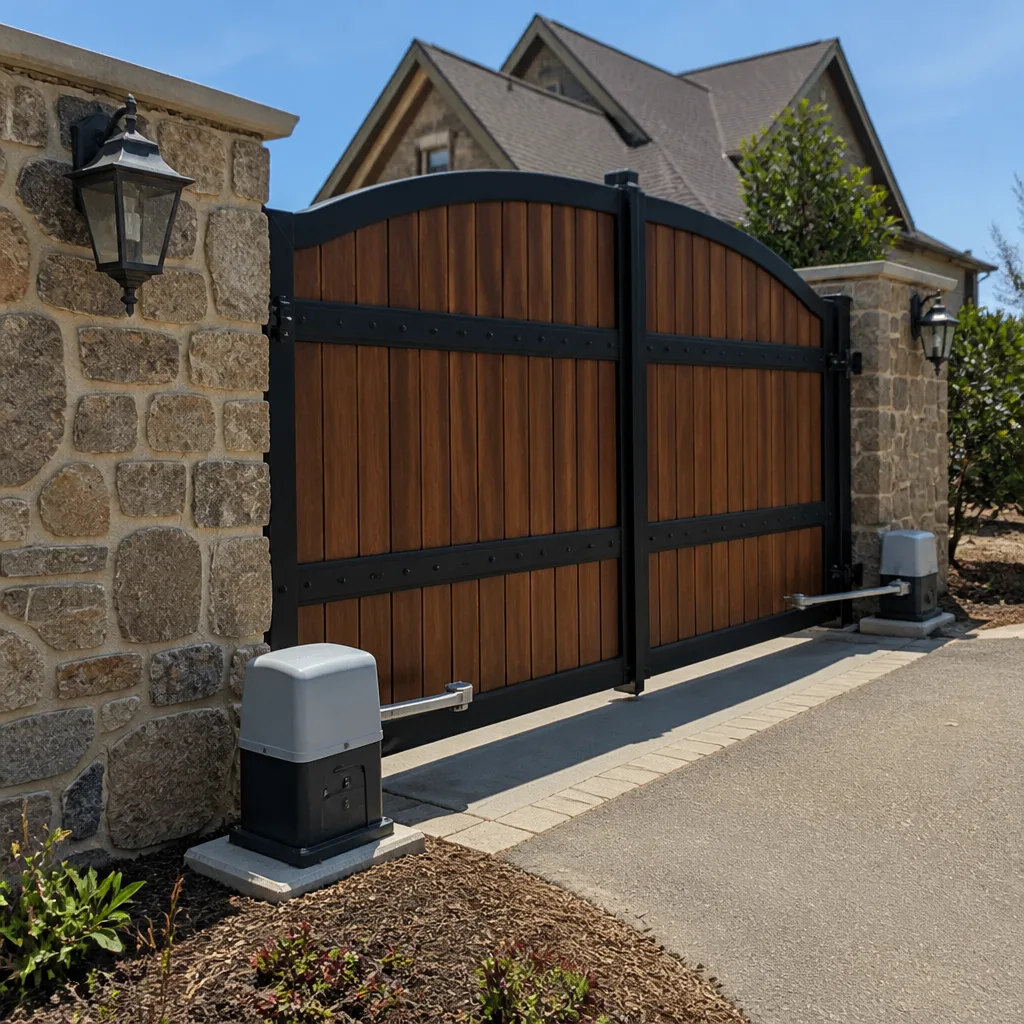
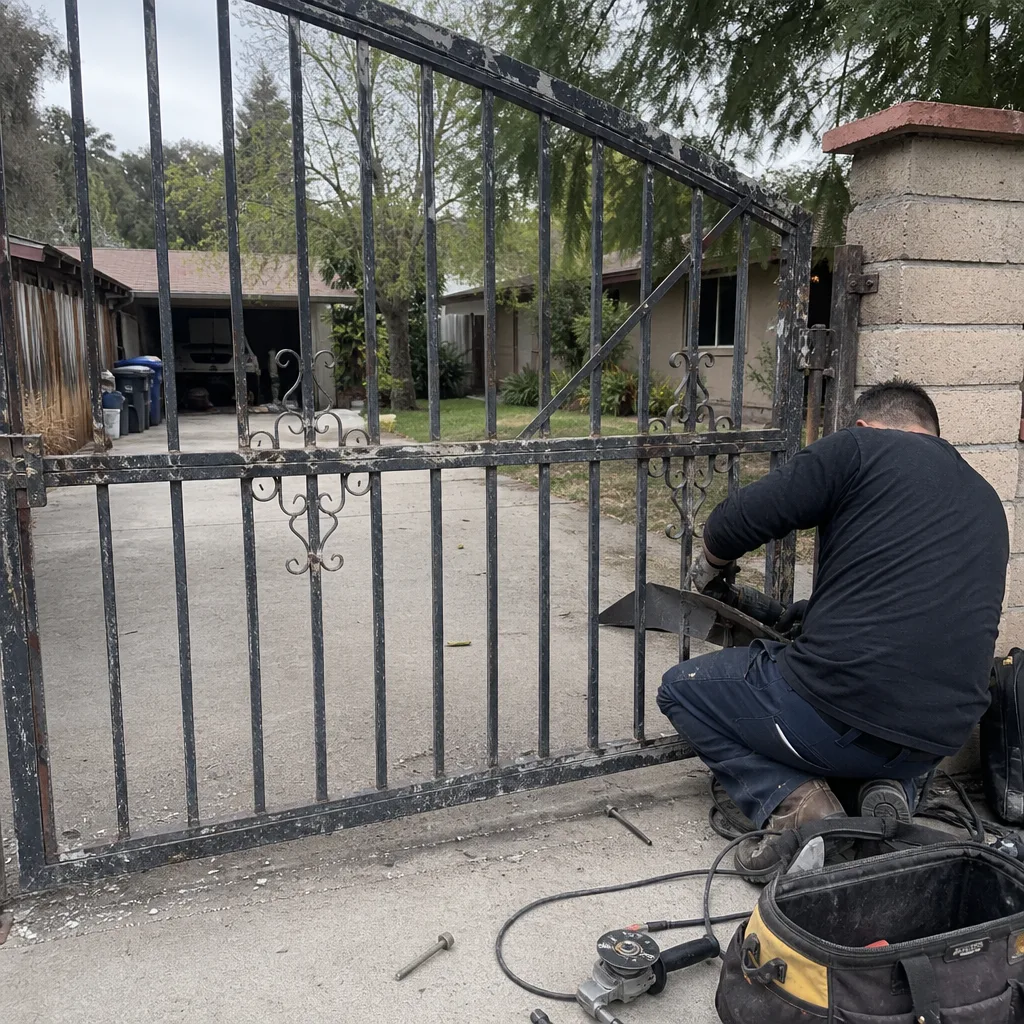 Before
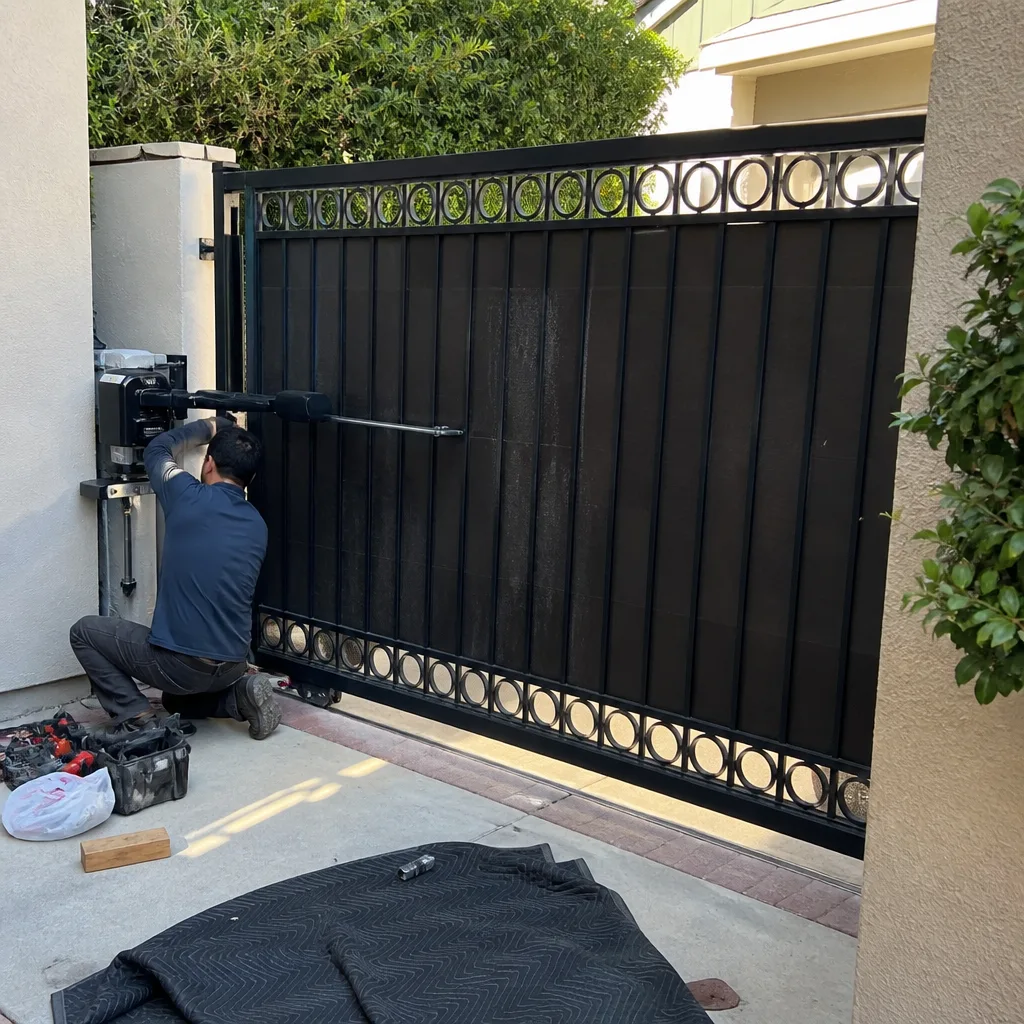 After
After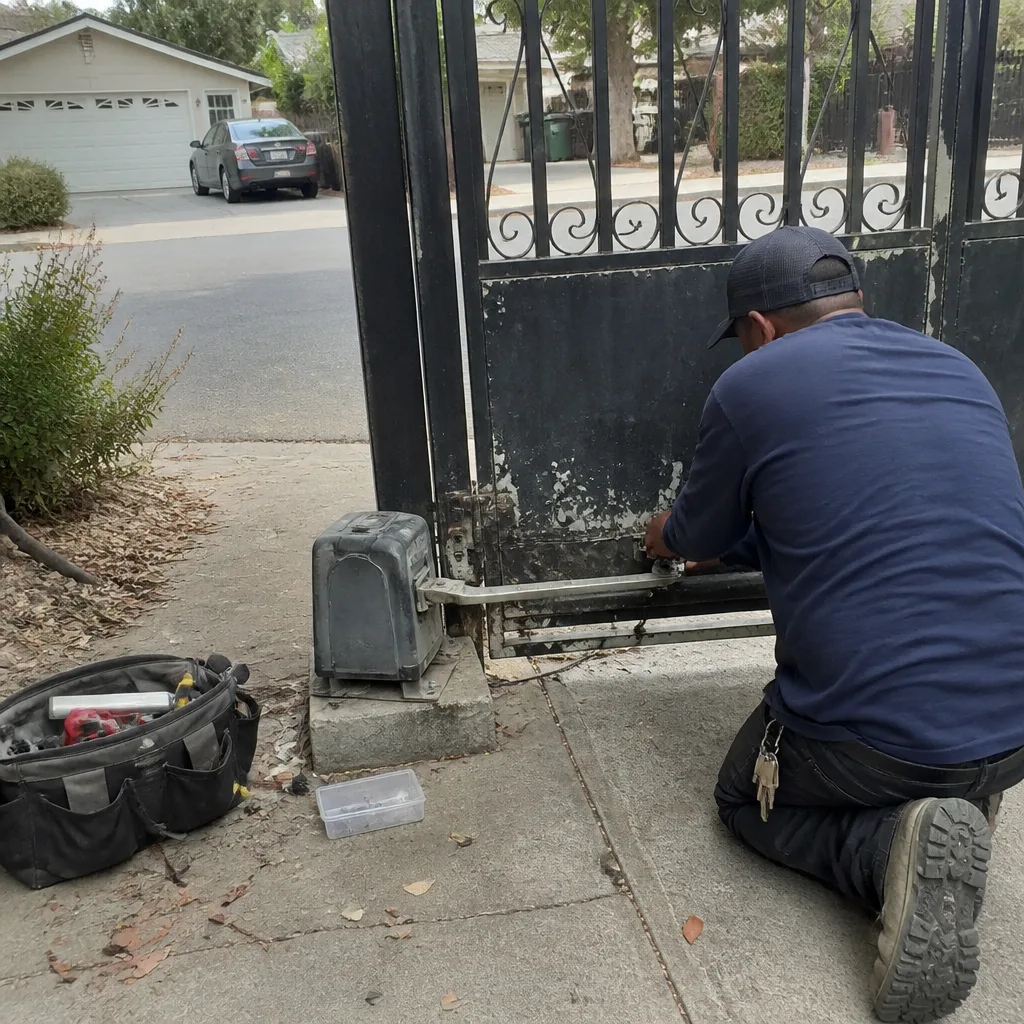 Before
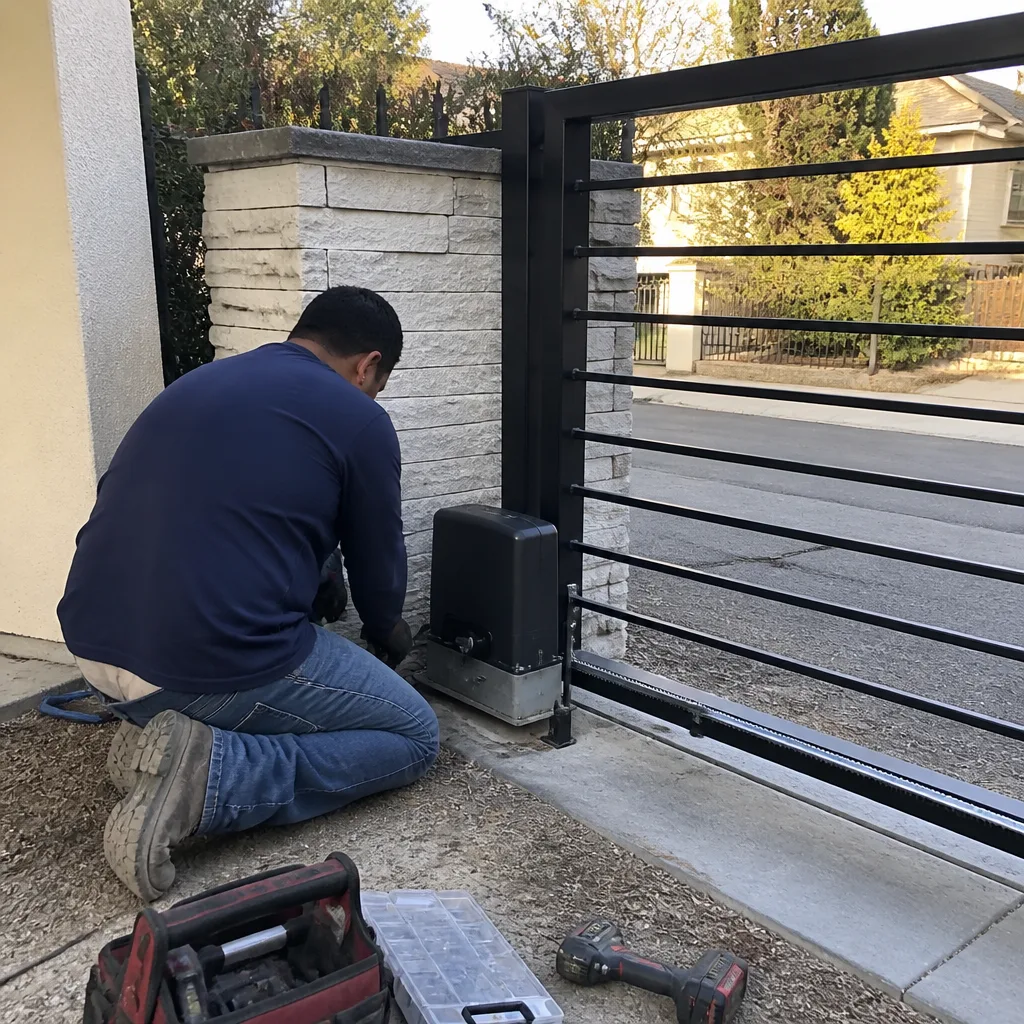 After
After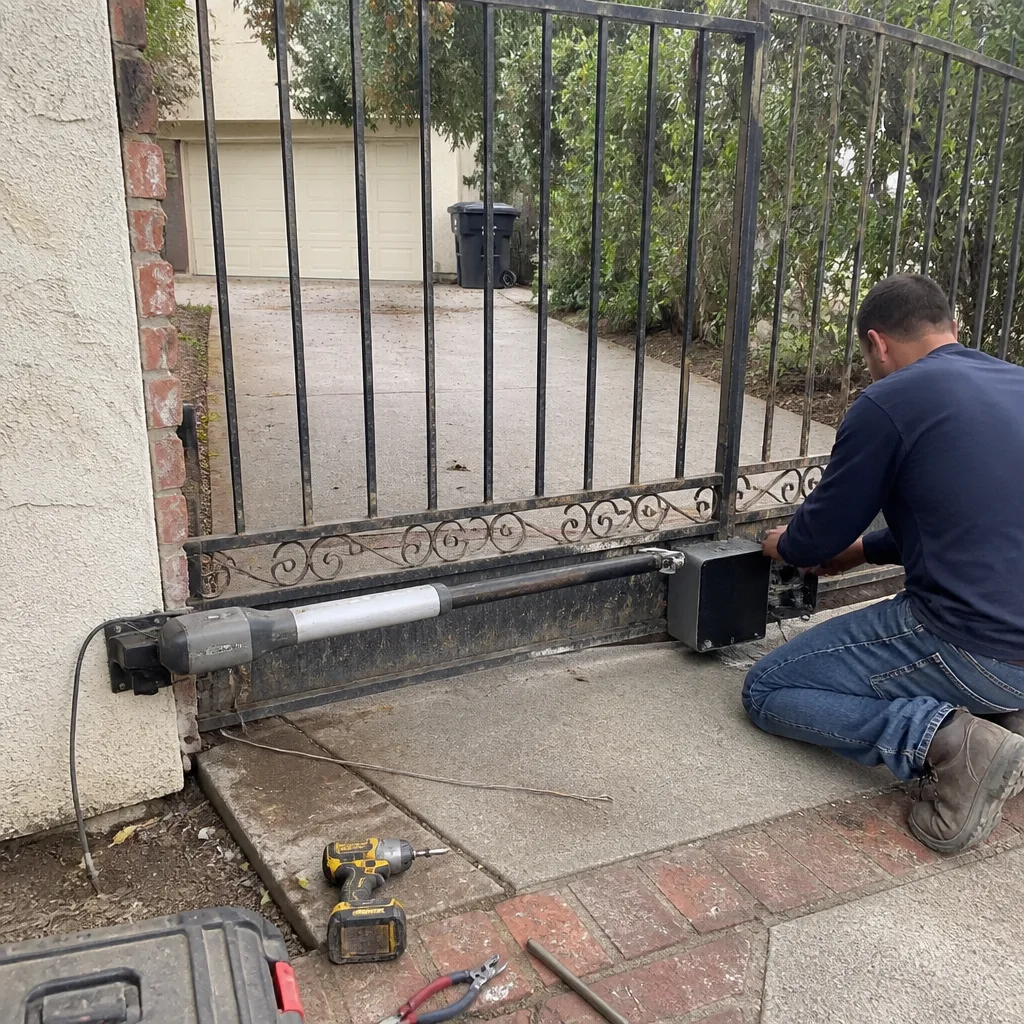 Before
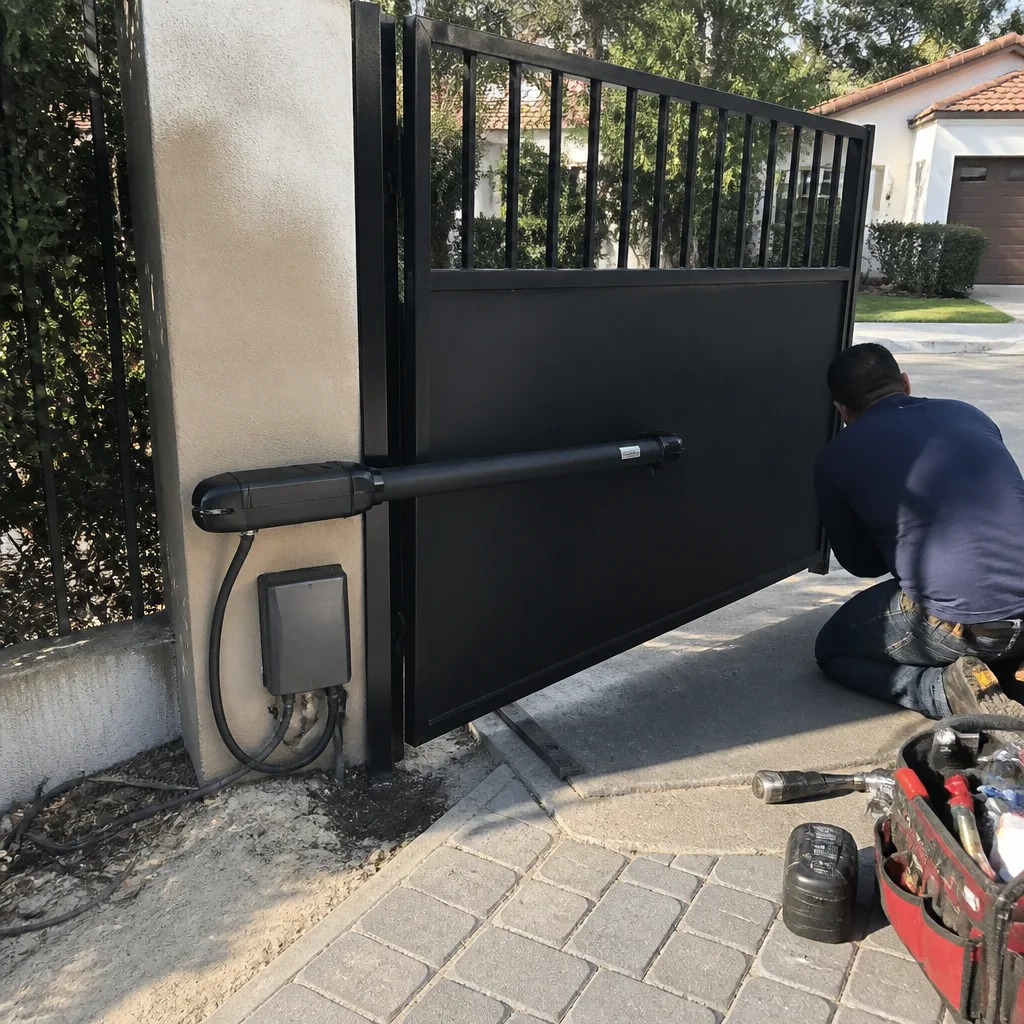 After
AfterDIY vs Professional Gate Repair: The Tarzana Homeowner’s Decision Guide
Here’s a number most Tarzana homeowners never hear: roughly 40% of the gate repairs we walk into started as a DIY attempt that went sideways. A gate is deceptively simple from the curb. Two posts, a slab of steel, a hinge, maybe a motor. But the physics of a 400-pound swinging or sliding gate are unforgiving, and the electronics on a modern opener are about as tolerant of guesswork as a smoke detector. This guide explains what a homeowner in Tarzana can reasonably handle with a wrench and a can of grease, what should be left to someone who does this every day, and how to tell the difference before you spend money twice. You’ll learn the real cost of both paths, what your gate is actually telling you when it groans, and how to make a decision you won’t regret in six months.
Quick Answer
For most Tarzana homeowners, the smart split is this: lubrication, cleaning, battery swaps, and visual inspections are reasonable DIY territory, while anything involving gate springs, hinge welding, motor electronics, or a gate that has come off its track is professional work. Attempting a structural or electrical repair without the right tools and training usually costs more to fix afterward than hiring a specialist the first time. The decision comes down to weight, electricity, and risk, not just willingness.
Table of Contents
- Know What Kind of Gate You Have
- What’s Actually Safe to Do Yourself
- Jobs You Should Not Attempt on Your Own
- What DIY Gate Repair Really Costs in Tarzana
- What Professional Gate Repair Costs in Tarzana
- How to Read Your Gate: The 7 Warning Signs That Separate Maintenance from Repair
- Automation and Access Control: Where DIY Almost Always Goes Wrong
- A Decision Framework for Every Tarzana Gate
Know What Kind of Gate You Have
Before you touch a single bolt, know what you are dealing with. Tarzana properties fall into a few broad gate types, and each one changes what DIY looks like. A lightweight tubular steel pedestrian gate on a side yard shares almost nothing with a 20-foot sliding driveway gate on a steel track. The first one weighs maybe 80 pounds and forgives a mistake. The second one weighs 600 to 900 pounds, carries momentum, and will break a finger or a wrist without noticing.
Most homes in the flat streets south of Ventura Boulevard, around Vanalden and Reseda, have swing gates. These are the classic paired gates that open outward or inward on heavy steel posts. They look simple and they are, until a hinge sags or a post shifts in the expansive clay soil that Tarzana shares with the rest of the west Valley. When that happens, the gate binds, the motor strains, and the problem compounds.
Sliding gates are more common on the larger lots up toward the Santa Monica Mountains, south of the Boulevard along hillside streets like Corbin and Wilbur. These run on a steel track or a cantilever system, and they depend on precise leveling. A quarter-inch of settlement in a concrete pad turns a smooth glide into a grinding mess. The motor that drives a sliding gate works harder than a swing gate motor, which means electrical problems surface faster when the gate is not kept in alignment.
Then there are pedestrian gates, driveway gates, and estate gates, plus the many combinations in between. The point is not to memorize categories. The point is to know that what works for one gate on one Tarzana street may be exactly wrong for the gate next door. Start by figuring out what you have, then decide what you can safely touch.
What’s Actually Safe to Do Yourself
There is a real list of maintenance tasks any careful Tarzana homeowner can handle. These jobs keep a gate working longer, cost almost nothing, and do not involve electricity, tensioned parts, or welds. In our experience, the homeowners who do these things get noticeably more years out of a gate between professional service calls.
- Lubricate the hinges and wheels. Use a white lithium grease or a dry silicone spray, not WD-40. WD-40 cleans but does not lubricate a loaded hinge. Do this every four to six months, before the dry season and after the rains. The Santa Ana winds push fine dust into everything, and that dust mixes with old grease into a grinding paste.
- Clean the track on a sliding gate. Leaves, acorns, and the fine sediment that washes down Tarzana hillsides collect in the track. Brush it out with a stiff brush and check for small stones. A pebble in the track is the most common cause of a sliding gate that jerks.
- Check the battery in your keypad and remote. If the gate starts responding slower, change the battery before you assume the motor is dying. A nine-volt battery swap solves more intermittent gate problems than most people think.
- Inspect visible bolts and brackets. Walk the gate once a month and look for anything loose, rusted, or cracked. If a bolt is loose on a hinge, tighten it. If a bracket is cracked, note it and call someone before it fails completely.
- Clear vegetation from the gate path. Tarzana has fast-growing bougainvillea, oleander, and ivy. When branches press against a swing gate or drag against the bottom of a sliding gate, they add load to the motor and scratch the finish. Keep a foot of clearance on both sides.
- Test the safety reversal. Most automatic gates (and all modern ones) have an obstruction sensor that reverses the gate if it hits something. Test it with a cardboard box once a season. If the gate does not reverse, stop using the automatic function until it is corrected. This is a genuinely important safety feature, not a convenience feature.
None of these jobs require special training or tools beyond what most Tarzana garages already have. They are maintenance, not repair. Know the line and you avoid both danger and wasted money.
Jobs You Should Not Attempt on Your Own
Now the other side of the line. Some gate repairs are dangerous enough that even we treat them with full respect after four decades in the trade. Here are the jobs we tell homeowners to walk away from, every time.
Gate springs and tension hardware. A gate spring under load stores energy like a drawn bow. If it lets go while you are removing or adjusting it, the hardware becomes a projectile. We have seen a spring take a chunk out of a stucco wall. A hand or face is no match for it. This is not a job for a socket set and a YouTube video. It is a job for training and the right clamps and jigs.
Anything involving welding. A broken hinge, a cracked post bracket, a snapped weld on a steel gate. A welder in untrained hands makes a bad joint look fine for about six months, then fails at the worst moment. We have rebuilt gates that collapsed after a handyman welded a hinge without proper penetration or heat control. The metal looked connected; the weld was cosmetic. There is no substitute for someone who welds gate steel weekly.
Electric motor repair and wiring. A gate opener runs on household voltage in most Tarzana installations, and the wiring runs through a metal post in the ground. Water, wire, and 120 volts are a combination that punishes experimentation. Beyond the shock risk, miswired motors burn out control boards. A $40 mistake becomes a $600 board replacement. If the motor is not responding and it is not a dead battery, stop.
A gate that has come off its track or sagged off its hinges. The weight is the issue. Even a modest driveway gate can outweigh a person. Getting it back into position requires lifting, blocking, and re-leveling under load. If a chain, a jack, or a block slips, the gate falls on whatever is under it. This is how fingers, feet, and car fenders get crushed.
Any repair on a gate you cannot positively identify. If you do not know the brand of the opener, whether it runs on DC or AC, or how the limit switches are set, you are guessing. Guessing on a gate opener is the most reliable way to turn a $150 repair into a $900 replacement. In Tarzana we work on homes with equipment from DoorKing, LiftMaster, Elite, Mighty Mule, and a half dozen other brands. Each one programs differently. Each one has its own failure patterns. The fix is seldom generic.
The common thread: weight, electricity, or tension. If the job involves any of the three at a scale that could injure you, it is not a DIY job. Call someone who owns the tools and the calibration.
What DIY Gate Repair Really Costs in Tarzana
The common wisdom says DIY is cheap and professionals are expensive. The reality in Tarzana is more complicated. A homeowner who buys the right lubricant and spends an hour maintaining a gate spends $20 and saves a service call. A homeowner who buys a generic opener control board online for $80, spends a Saturday installing it, and then discovers it is incompatible with the existing safety sensor loop has now spent $80 plus a Saturday, and still needs the professional call. That second outcome is not rare. We see a version of it every month.
Factor in what Tarzana actually costs. Tool purchases, even basic ones like a quality socket set and a multimeter, add up. Parts are more expensive for homeowners than for a shop with trade accounts. And time has value. A homeowner who spends six hours fighting a gate that a technician would fix in 45 minutes has not saved money; they have traded a weekend for a repair.
There is also the cost of the follow-up repair when the DIY attempt makes the problem worse. A stripped hinge bolt becomes a drilling and re-tapping job. A misaligned safety sensor becomes a service call with diagnosis time added. The savings on the front end evaporates quickly on the back end.
We are not saying never touch your gate. We are saying be honest about what the attempt is likely to cost you in time, tools, parts, and the chance of a worse problem. Maintenance DIY is a good trade. Repair DIY on mechanical or electrical components is a gamble, and the odds in Tarzana are not in your favor.
What Professional Gate Repair Costs in Tarzana
The honest answer is that it depends on the problem, but here are the ranges we see across the west Valley for common gate work. These are the numbers homeowners can use to sanity-check an estimate.
- Service call and diagnosis: $75 to $125, often waived if you proceed with the repair.
- Hinge replacement (set of two, steel swing gate): $180 to $340, including adjustment and re-hanging.
- Gate opener motor replacement: $450 to $1,200 depending on brand, horsepower, and whether the control board and safety edges also need replacement.
- Control board replacement: $250 to $600, including reprogramming of remotes and keypad. Brands like DoorKing and LiftMaster have board prices that vary widely by model.
- Sliding gate track repair and re-leveling: $350 to $900 depending on the length of track and whether the concrete pad needs work.
- Welding repair (cracked hinge bracket, broken gate frame member): $150 to $500 depending on location, accessibility, and how much grinding and repainting is needed.
- Keypad and access control replacement: $200 to $700 depending on whether it is a standalone keypad or a full telephone-entry system.
- Full safety system retrofit (photo eyes and safety edges): $350 to $800.
Every reputable shop in Tarzana quotes the job before starting. No one should do work on your gate without a number you have agreed to in advance. If a technician will not quote before beginning, that is your signal to find another company. At Ironworks Gate Co., the price is settled before the first bolt is turned. No surprises on the bill, ever. That is the square deal, and it is the only way we have done business for over 42 years.
How to Read Your Gate: The 7 Warning Signs That Separate Maintenance from Repair
Most gate failures do not happen suddenly. They announce themselves over weeks. A homeowner who knows the warnings can catch a problem at the maintenance stage, before it becomes a repair, and long before it becomes a replacement. Here are the seven signals we teach homeowners to watch for.
- The gate groans or squeaks when it moves. This means a dry hinge, a dry wheel bearing, or a misaligned track. Lubricate first. If the sound persists after lubrication, the wear is already past grease. Do not keep operating the gate and hoping it quiets down.
- The gate moves slower than it used to. A swing gate that used to take 12 seconds and now takes 20 is telling you the motor is working against extra resistance. That resistance may be a sagging hinge, a binding wheel, or a low battery in a solar installation. Ignoring it burns out the motor.
- The gate hesitates, stutters, or reverses for no visible reason. This is often a safety sensor or a low-voltage problem. Check the sensor alignment and the battery first. If those are fine, the control board or the motor capacitor may be failing.
- The gate does not close all the way, leaving a small gap. A limit switch issue, debris in the track, or a hinge that has settled. Do not keep forcing the gate closed manually if the motor is still connected. You can strip the gearbox.
- The gate drifts open or closed on its own after stopping. On a swing gate, this usually means a failed or misadjusted gate closer spring. On a sliding gate, it means the track is out of level. Both need a professional.
- Visible rust or cracking around welds and bolt holes. Rust at a weld joint is a structural red flag. Surface rust can be cleaned and painted. Rust that flakes in layers means the steel is losing section. Cracks mean the gate is moving under stress and the weld is failing.
- The opener hums but the gate does not move. Classic signs of a stripped gear, a failed capacitor, or a disconnected drive chain. Stop pressing the button. Continued attempts will fry the motor.
When you see any of these, you now know which side of the DIY line the problem sits on. Lights, batteries, lubrication, and loose visible bolts are in play. Everything else moves toward a professional call, and sooner is always cheaper than later.
Automation and Access Control: Where DIY Almost Always Goes Wrong
More than any other part of the gate world, automation trips up capable homeowners. A Tarzana homeowner who can rewire a ceiling fan or replace a car alternator will open a gate control box and see a world they understand just well enough to get into trouble. Low-voltage wiring, limit switches, force adjustments, obstruction sensors, radio receivers, and backup batteries all interact. Changing one setting without understanding the others is how gates end up out of calibration.
Each major opener brand programs differently. A DoorKing board does not use the same button sequences or LED codes as a LiftMaster board. An Elite system does not respond like a Mighty Mule. We are trained and equipped on nine gate-automation brands for exactly this reason. The fix that works on one driveway does not necessarily transfer to the one next door, even if the gates look identical from the street.
The other issue is safety calibration. Modern gate openers are required to have obstruction detection that reverses the gate when it meets resistance. That sensitivity setting is not a suggestion; it is a safety feature that prevents a child or a pet from being crushed. A homeowner who adjusts the force setting too high because “the gate kept reversing for no reason” has disabled a safety system, not fixed an annoyance. There is a real difference between a gate that is misaligned and a gate that is unsafe. Professional training exists to tell those two apart.
Access control adds another layer. Keypads, telephone entry systems, vehicle detectors, loop sensors, and intercom wiring all fail in their own ways, and diagnosing them requires both electrical knowledge and experience with how the specific brand fails over time. The generalist handyman who “does gates too” is often in over his head at this point. That is not a knock on handymen; it is an acknowledgment that gate automation is a trade of its own.
A Decision Framework for Every Tarzana Gate
Here is the simple framework we use, and we offer it to Tarzana homeowners without charge. When something is wrong with your gate, run it through these four questions in order.
- Is the problem limited to lubrication, cleaning, a battery, or a visible loose bolt? If yes, handle it yourself. If you are not sure, describe the symptom to a professional over the phone before touching anything. A live person answers at Ironworks Gate Co. 24 hours a day, 7 days a week, and we are glad to talk through whether something is worth a service call.
- Does the problem involve a spring, a welded joint, a track that is out of level, or a gate that has shifted on its hinges? If yes, it is structural work. Call a gate specialist. This is the category where DIY failures are most expensive.
- Does the problem involve the opener motor, the control board, safety sensors, or access control wiring? If yes, it is automation work. Call a gate specialist who knows your opener brand. Ask the company on the phone which brands they service before booking. If they cannot answer clearly, keep looking.
- Even if the job is borderline, what is the cost of being wrong? A sliding gate that weighs 700 pounds falling on a car, a person, or a child is not a risk worth taking to save a service call fee. The most expensive gate repair is the one you pay for twice.
That is the whole framework. It is not complicated because gate work, at the decision level, is not complicated. The complication lives inside the job itself, and that is the part a specialist handles. As the dedicated gate specialist for the west Valley, Ironworks Gate Co. handles the full scope: gate repair, gate installation, gate motors and openers, access control, and parts and welding. The company that makes a 40-year-old gate close like the day it was hung is the standard we work to every day. Visit our Ironworks Gate Co. home to see what we cover and where we serve.
Common Mistakes to Avoid
- Using WD-40 instead of real grease on hinges. WD-40 is a solvent and water displacer. It washes out the existing lubrication and leaves the hinge dry. A week later, the gate squeaks worse than before.
- Over-tightening hinge bolts to “fix” a sagging gate. This strips threads, cracks brackets, and does nothing to address the root cause, which is usually a worn hinge or a settled post. Tightening a sagging gate is like adjusting the mirror to fix a bent axle.
- Adjusting the opener’s force setting to stop false reversals. This disables the safety system. If your gate keeps reversing for no reason, something is wrong with alignment or sensors, not the sensitivity. Fix the cause, not the symptom.
- Buying a generic replacement part online based on looks alone. Gate parts are not standardized across brands or even across model years of the same brand. The board that looks identical may not talk to your remote, your sensors, or your motor.
- Ignoring rust at weld joints assuming it is cosmetic. In Tarzana’s dry-summer, wet-winter climate, rust at a weld means moisture is working into the joint. Surface rust is cosmetic; flaking or pitted rust at a weld is structural. Early treatment is a $100 repaint. Late treatment is a $500 weld repair or a gate replacement.
- Trying to lift a gate back onto its track with a car jack and scrap wood. Gates are pinch points and drop hazards. A 400-pound gate does not care about your intentions or your reaction time. This is how serious injuries happen.
- Calling the lowest bidder without asking about gate automation certifications. A wrong diagnosis on a control board costs more than the price difference between a cheap call and the right call. Tarzana homeowners who have been burned before know the cheapest quote on the phone is rarely the cheapest job in the end.
When to Call a Professional
Call a professional when the job involves weight, electricity, tension, or welding, and do it before the problem compounds. A gate that sags off its hinges will damage the motor as it binds. A motor that fights extra resistance will burn out its own board. A crack that starts the width of a dime becomes a broken gate in under a year. If you are located in Tarzana and any of the seven warning signs above describes your gate, the fastest path to a correct diagnosis is a phone call. Ironworks Gate Co. offers free estimates in Tarzana, and every job is quoted and agreed before work begins. Call (925) 263-6107 and speak to a person, any hour, any day.
Frequently Asked Questions
Most gate repairs in Tarzana run between $180 and $900 depending on the problem, with simple hinge replacements at the low end and sliding track rebuilds at the high end. Motor and control board replacements can run higher, from $450 to $1,200 depending on brand and model. The only way to know your exact number is a diagnosis; call (925) 263-6107 for a free estimate before committing to anything.
You can replace remote and keypad batteries yourself, and you can check for obvious obstructions and misaligned sensors, but any repair that involves the control board, motor, or wiring is professional work. Miswiring a gate opener is both dangerous and expensive, and most homeowners who attempt it end up paying for the repair twice. If the gate is humming, stuttering, or not responding, call a specialist.
We are trained and equipped on nine major gate-automation brands: LiftMaster, FAAC, BFT, Linear, Viking, Ghost Controls, DoorKing, Elite, and Mighty Mule. That coverage means we carry the right boards, remotes, and diagnostic tools for whatever is on your driveway, usually completing most jobs in a single visit. If you are not sure what brand you have, one of our technicians can identify it in minutes.
Yes, a sagging gate is dangerous in two ways. The gate itself gets heavier and less stable as the hinges wear, increasing the load on the motor and the chance of a mechanical failure. More seriously, a gate that sags off its hinges can fall if a bracket gives way. A driveway gate can weigh hundreds of pounds, and a falling gate is a serious injury risk. Sagging is structural, not cosmetic; address it promptly.
Permits are generally not required for replacing hinges, wheels, motors, or control boards on an existing gate in Tarzana, nor for welding repairs that restore the gate to its original condition. Work that changes the gate’s size, height, or location, or that runs new electrical service from the street, may trigger city review. A qualified gate contractor can tell you in the first five minutes whether your job falls into that category.
We answer the phone 24 hours a day, 7 days a week, and we staff Tarzana and the surrounding west Valley with local technicians who carry common parts on the truck. Most repair jobs in Tarzana are completed in a single visit, and we always quote the price before work begins. If your gate is stuck open or closed, call (925) 263-6107 and you will talk to a person, not a voicemail tree.
Every job we complete, in Tarzana or anywhere else we serve, is covered by our 90-Day Done Right Promise. It is a written guarantee: if the work is not right, we come back and make it right, no paperwork and no arguing. The promise applies to all gate repair, installation, motor, and access control work. We call it the Keystone Standard internally, because a job is not done unless it is done right and backed in writing.
The Bottom Line
DIY gate repair has a place, and that place is small: lubrication, cleaning, batteries, and monthly visual checks. Everything else sits on the other side of a line defined by weight, electricity, tension, and welding, and crossing that line without training invites an injury or a double repair bill. Tarzana homeowners who read the warnings, respect the weight, and call a specialist for structural or automation work will spend less over the life of a gate than those who gamble. If your gate is telling you something, listen to it. The fix starts with a phone call, and the right call is the one you make before the problem gets worse.
Written by Victor Salinas, Owner at Ironworks Gate Co., serving Tarzana since 2013.