
Last updated August 25, 2026
Free on-site gate assessment - hinges, posts, and your LiftMaster or Nice gate operator checked before anything is quoted
The assessment is free and the quote is the invoice.
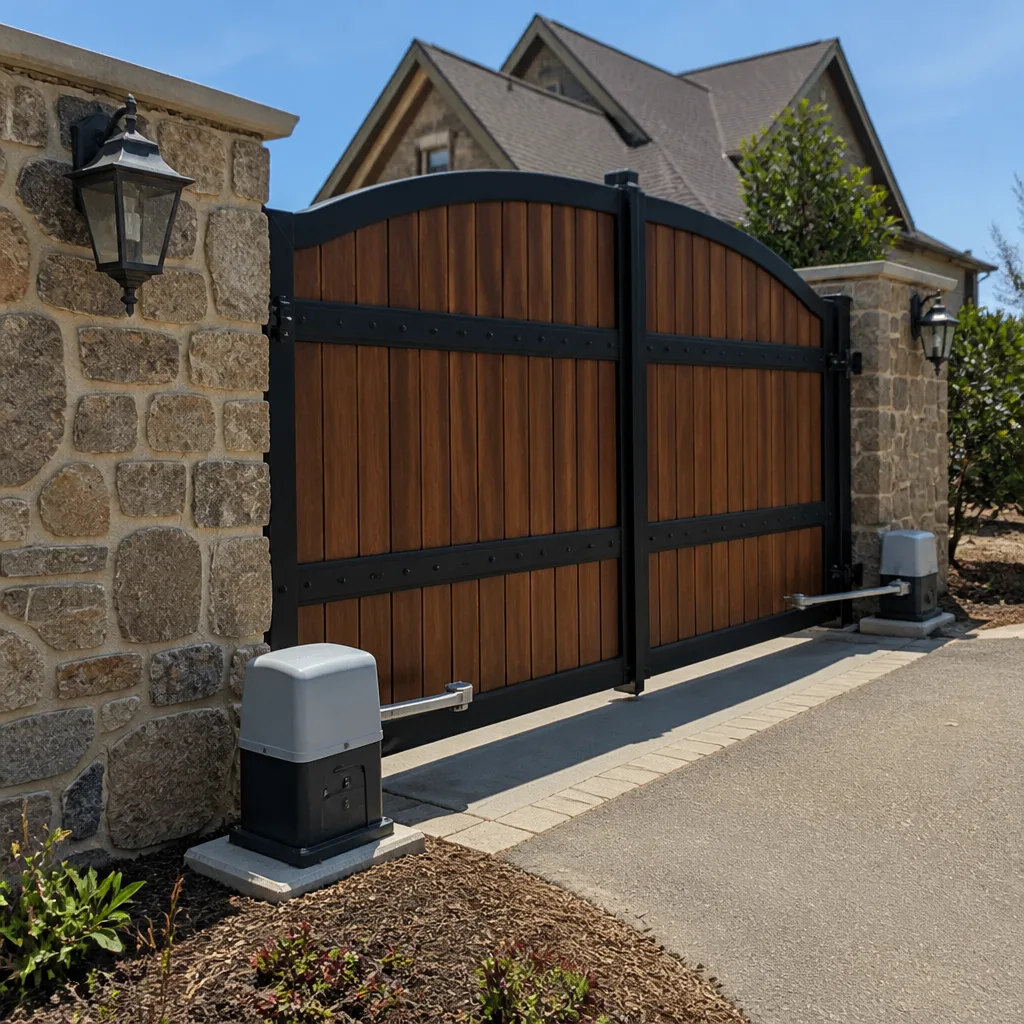
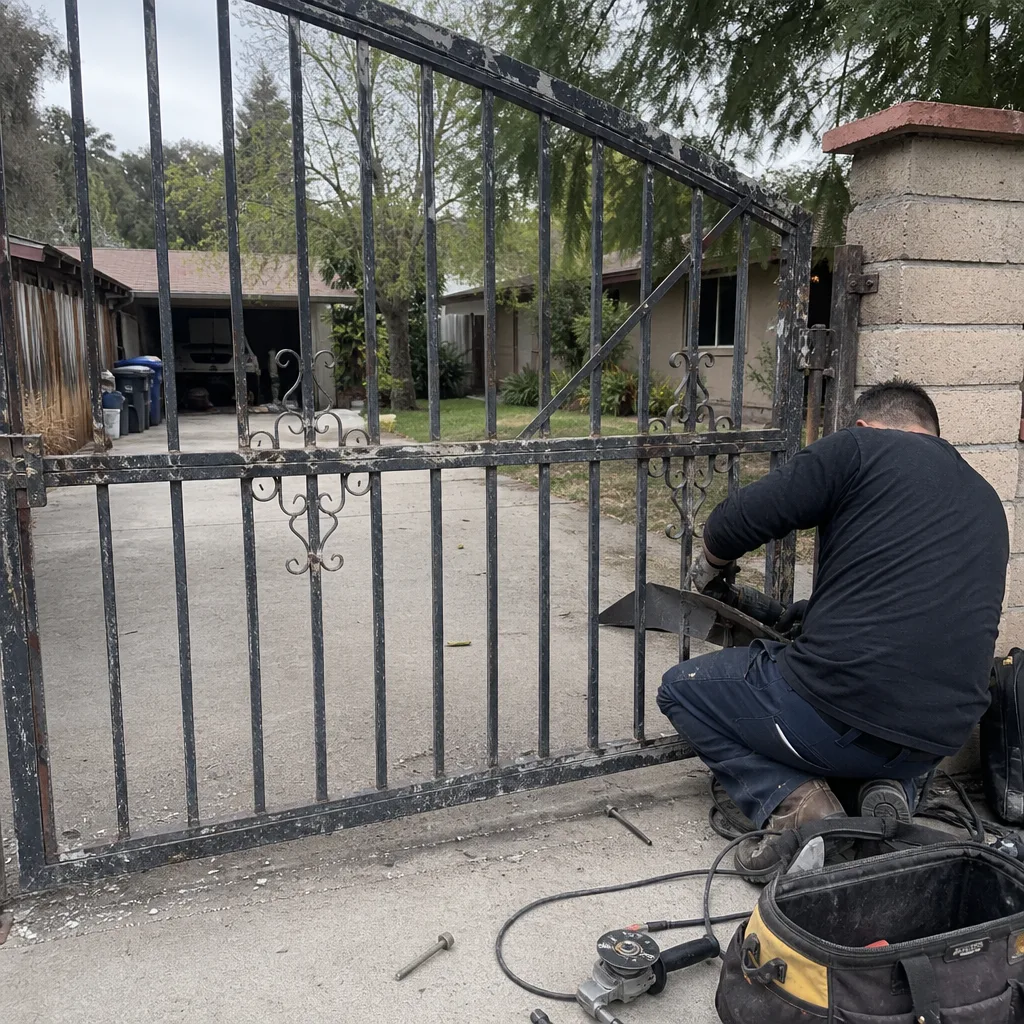 Before
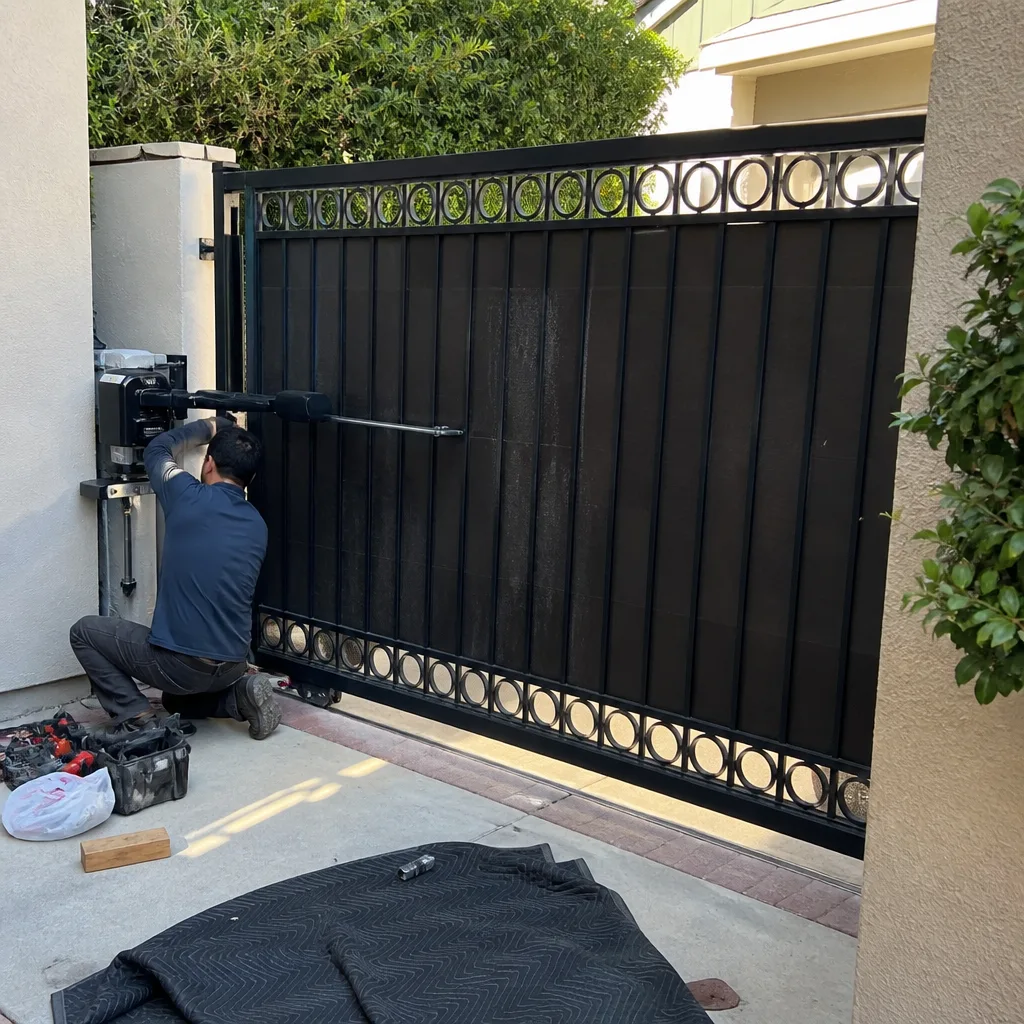 After
After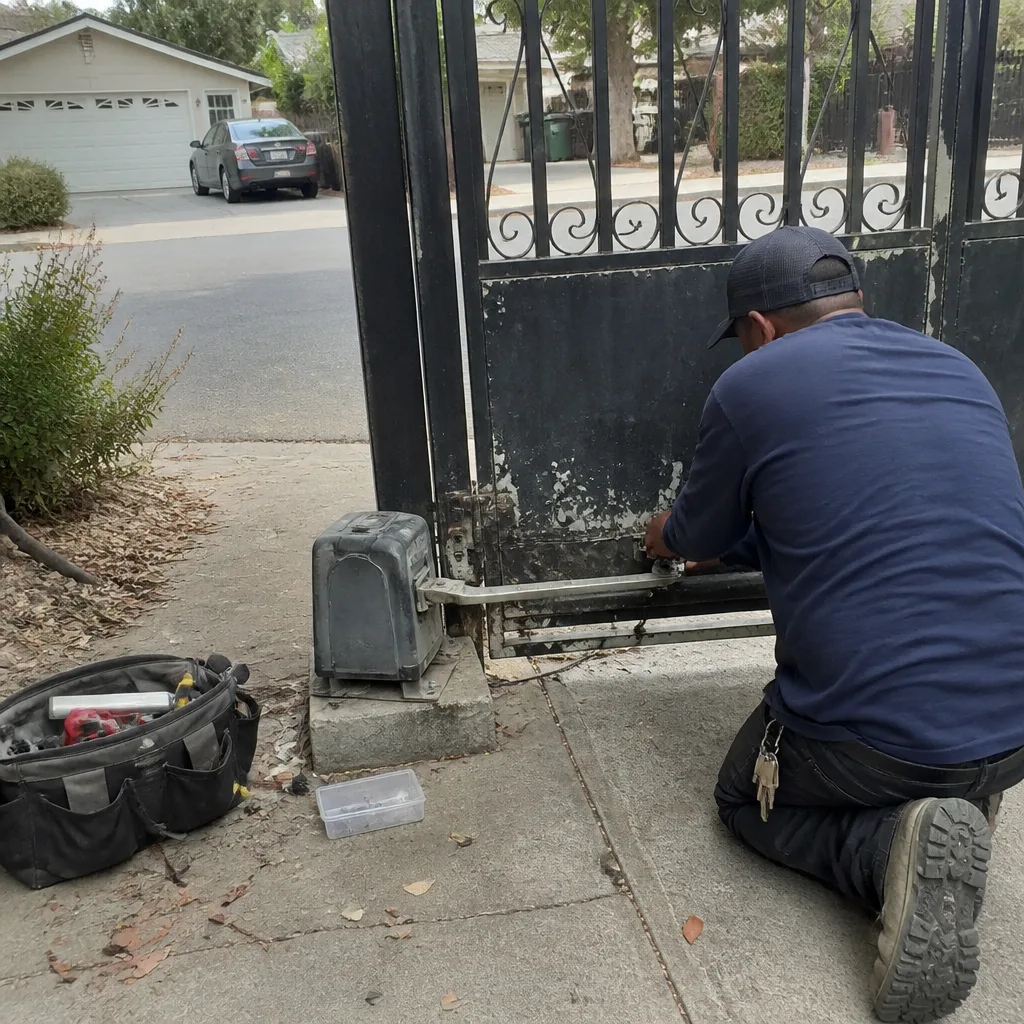 Before
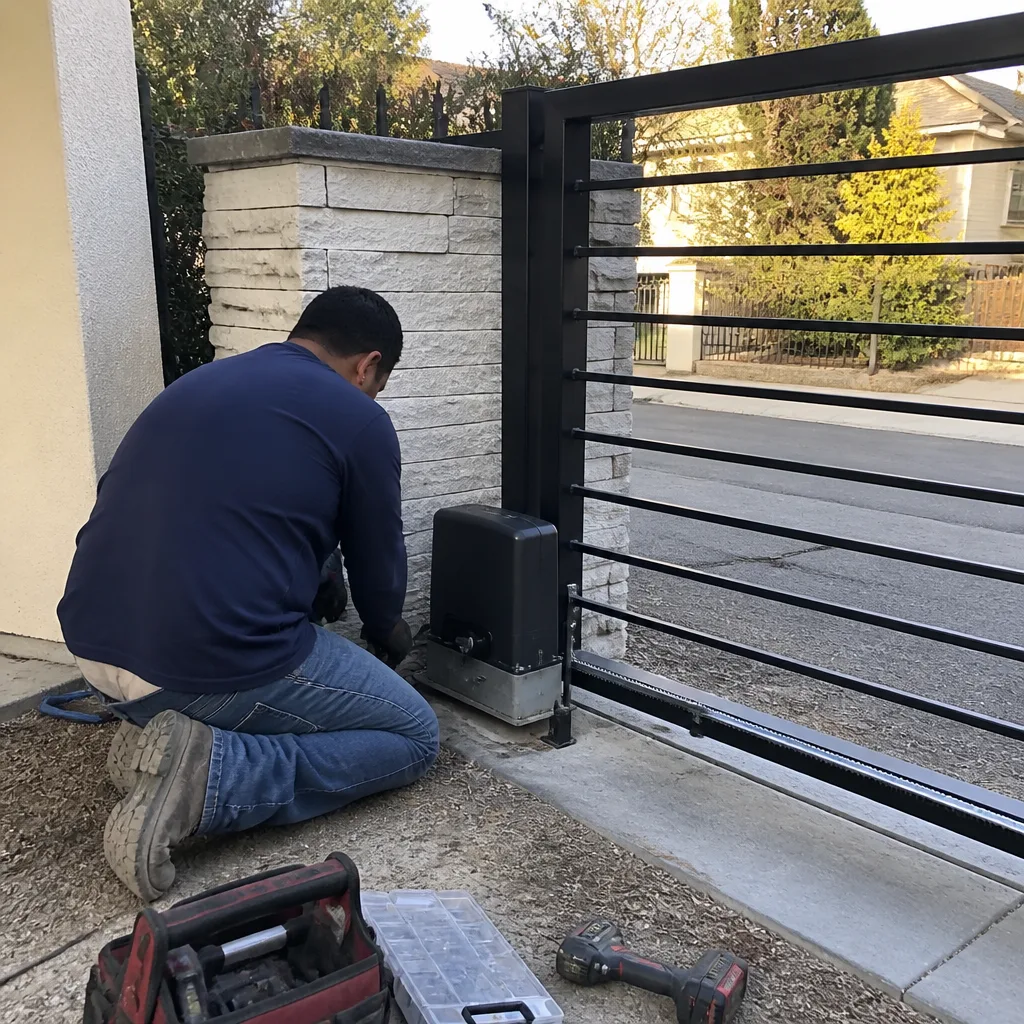 After
After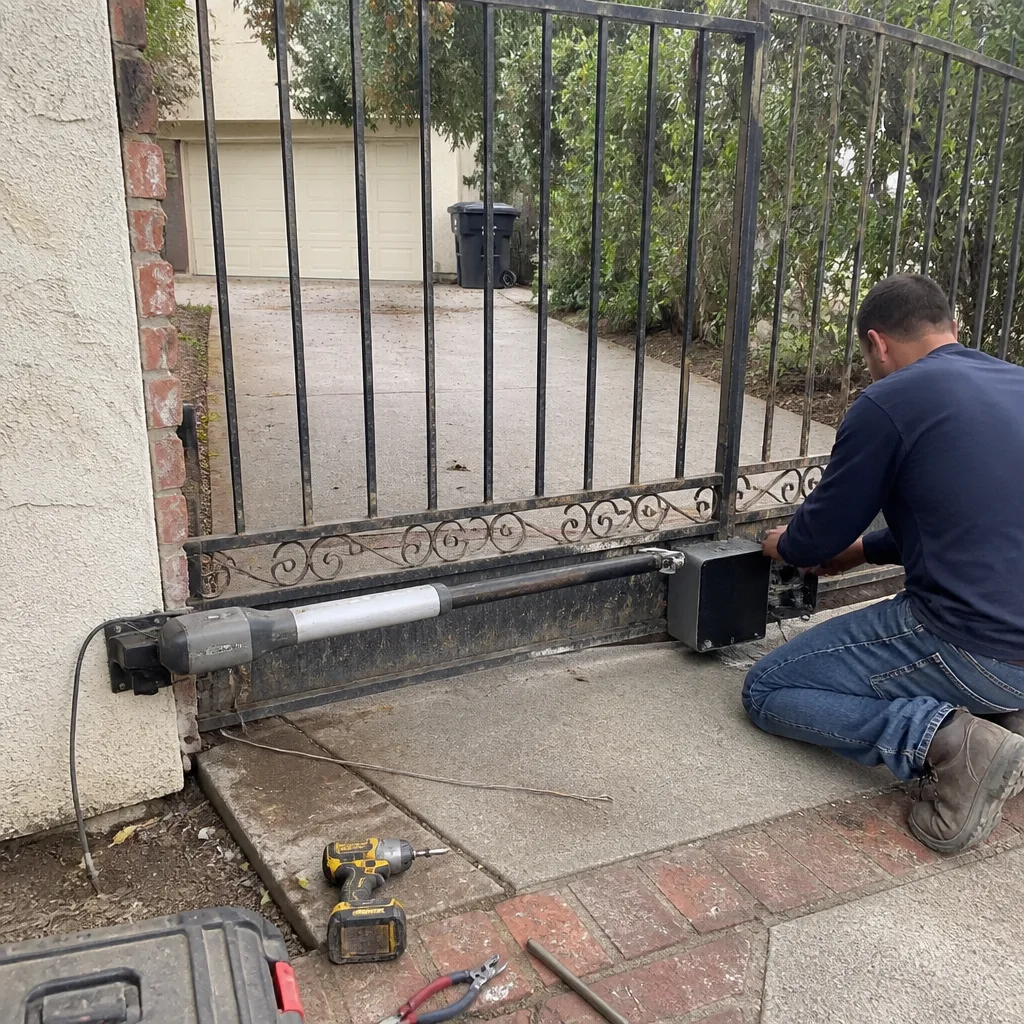 Before
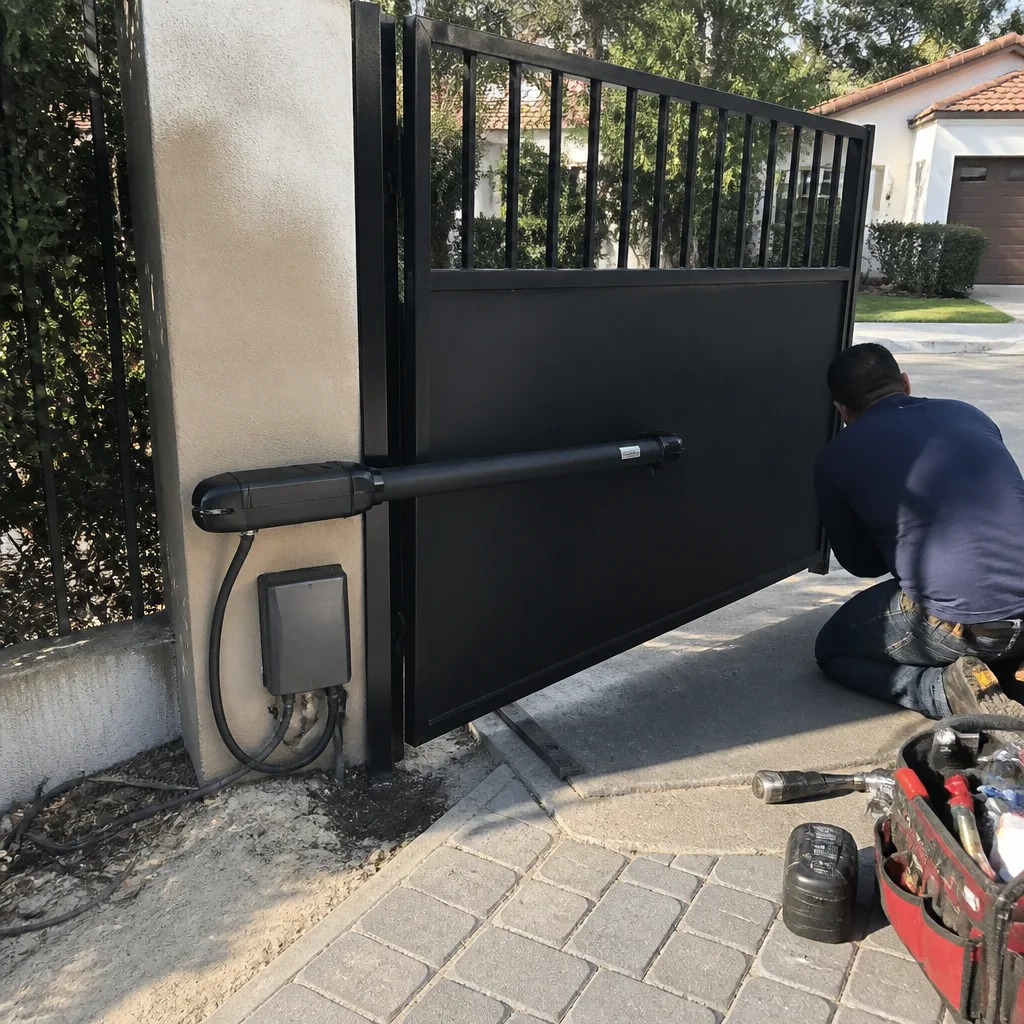 After
AfterGate Repair Warning Signs: A Tarzana Homeowner’s Reference Guide
Most gate failures in Tarzana don’t happen suddenly. They announce themselves weeks or months in advance, through small sounds and subtle shifts that are easy to dismiss as normal wear. A gate that groans today is a gate that refuses to open on a Monday morning, usually right before work or school. This guide walks through the warning signs we’ve learned to recognize over more than four decades of gate work in the San Fernando Valley, what each one means, what it costs to fix, and when it’s time to call someone rather than watch it get worse.
Quick Answer
Gate repair warning signs in Tarzana fall into seven categories: unusual noise, slow or jerky movement, sagging or dragging, opener motor issues, rust and metal fatigue, electrical or sensor failures, and remote or keypad problems. If your gate makes a new sound, moves differently than it did last month, or shows visible rust at the welds or hinges, address it within two to three weeks. Small fixes now typically run $150 to $400; full motor or structural replacement after a failure typically runs $1,200 to $4,500.
Table of Contents
- Unusual Noises: What Your Gate Is Trying to Tell You
- Slow, Jerky, or Uneven Movement
- Sagging Gates and Dragging Ends
- Opener Motor Warning Signs
- Rust, Cracks, and Metal Fatigue
- Electrical, Sensor, and Safety Edge Problems
- Remote, Keypad, and Access Control Failures
- Common Mistakes to Avoid
- When to Call a Professional
- Frequently Asked Questions
- The Bottom Line
Unusual Noises: What Your Gate Is Trying to Tell You
A properly maintained gate makes almost no sound. You should hear the soft hum of the motor and the faint click of the limit switch, nothing more. When a gate in Tarzana starts to grind, squeal, clunk, or rattle, something has changed mechanically. The sound itself tells you where to look.
A high-pitched squeal usually points to dry hinge or wheel bearings. On a swing gate, you’ll hear it at the hinge pivot. On a slide gate, it comes from the track rollers. Left alone, dry bearings wear unevenly, then seize, transferring stress to the motor and the gate frame. We’ve replaced many motors in Tarzana where the real culprit was a $12 bearing that never got greased.
A grinding or metal-on-metal scrape typically means the gate has shifted out of alignment. The gate frame is contacting the post, the ground, or the track itself. In Tarzana’s dry, hot summers, the ground contracts and shifts, and a gate that cleared fine in February can drag by August. The scrape is the gate telling you it’s working harder than it should.
A rhythmic clunk or thump during travel often indicates a broken or loose component on a chain-drive opener. The chain slips over a worn sprocket, or a pulley has come loose from its mount. Every clunk is one more impact on a part that’s supposed to move smoothly.
Here’s what each sound generally means, in order of urgency:
- Squeal or squeak: Dry bearings or hinges. Grease or replace now. Cost to fix: $80 to $200 if caught early.
- Grinding or scraping: Gate out of alignment, dragging on concrete or post. Adjust and realign now. Cost: $150 to $400.
- Clunking or thumping: Loose chain, worn sprocket, or loose mount. Tighten or replace before the chain jumps. Cost: $120 to $350.
- Rattling: Loose bolts or brackets vibrating during travel. Tighten now. Cost: $75 to $150 if caught before parts fail.
- Humming without movement: Motor running but gate not moving. Capacitor or gear failure inside the opener. Stop using the gate and call a professional. Cost: $200 to $600 for the repair, $900 to $2,500 for a full opener replacement.
Any new sound is a reason to stop and look. The sooner a noise is traced, the smaller the repair bill. In our experience, Tarzana homeowners who call within a week of the first strange sound spend about a third of what those who wait a month spend.
Slow, Jerky, or Uneven Movement
A gate that opens and closes at a consistent speed is a healthy gate. When that speed changes, the cause is almost always mechanical resistance or a failing motor. The gate is working against something it didn’t have to fight before.
Here’s the sequence we recommend in Tarzana when a gate slows or jerks:
- Watch the full travel cycle. Stand where you can see the entire arc or slide path. Note where the gate slows or hesitates. The location of the hesitation tells you where the problem lives.
- Listen at the slow point. If you hear scraping or grinding at the same spot every cycle, the gate is binding against something: a shifted post, a raised section of concrete, a bent track, or debris in the wheel path.
- Check the track or hinge area for obstructions. In Tarzana, eucalyptus leaves, palm fronds, and wind-blown debris collect in slide gate tracks regularly. A twig jammed in the track creates drag that mimics a mechanical failure.
- Disengage the opener and push the gate by hand. If the gate moves easily by hand, the resistance is in the motor or gearbox. If it’s hard to push, the problem is mechanical: hinges, wheels, track, or alignment.
- Watch the gate at the very end of its travel. A gate that slows to a crawl near the closed position is often fighting a misadjusted limit switch, which is a simple opener adjustment, not a structural problem.
Jerky movement, where the gate stutters or lurches forward, has its own set of causes. On a slide gate, a worn drive gear or a chain with uneven tension produces a stutter with every rotation. On a swing gate, jerky movement often traces to a worn pivot bearing or a bent hinge pin.
One thing we tell every Tarzana homeowner: a gate that moves slowly is a gate that is about to stop moving entirely. The motor is drawing more current to push through the resistance, and that current turns into heat. Heat kills opener motors. A $180 alignment adjustment and bearing service done now prevents a $1,500 motor replacement in six months.
If you have a LiftMaster or DoorKing opener that’s been in service for more than ten years, pay close attention to any speed change. Those units are built to last, but they give exactly this kind of warning before the gearbox or motor gives out.
Sagging Gates and Dragging Ends
Sagging is the most visible warning sign on any swing gate, and it’s the one Tarzana homeowners tend to underestimate. A gate that drags an inch on the driveway today will drag three inches in a year, and every inch of drag is multiplied stress on the hinges, the post, and the opener.
Here’s what sagging tells you, and why it matters.
Hinge wear is the usual cause. A large wrought iron or steel gate can weigh between 400 and 1,200 pounds. All of that weight hangs on two or three hinge assemblies. Over the years, the hinge pins wear, the hinge barrels stretch, and the gate drops. In Tarzana’s heat, the metal expands and contracts daily, which accelerates the wear cycle.
The post is the second common cause. A gate post that wasn’t set deep enough or wasn’t braced properly will lean under the gate’s weight. You can see this from the top: if the gap at the top of the gate is wider than the gap at the bottom, the post is moving. A leaning post is a structural problem, not a hinge problem, and it requires resetting or bracing the post, not just shimming the hinge.
What sagging costs to fix:
- Hinge replacement with gate realignment: $250 to $600, depending on gate weight and hinge quality.
- Hinge repair plus post bracing: $400 to $900, depending on post condition and access.
- Post reset in new concrete with proper depth: $800 to $2,000, depending on post size, gate weight, and whether the old post can be salvaged.
- Full gate fabrication and re-hang: $2,500 to $6,000 for a new custom gate built to match the existing style.
The drag itself causes a second problem: it wears a groove in the concrete or asphalt driveway, which adds friction every cycle. That friction loads the opener motor, which shortens its life. Fix the sag and you protect the motor. Ignore the sag and you eventually replace both the gate hardware and the opener.
Opener Motor Warning Signs
The motor is the component most likely to fail without warning, but it still gives signals if you know what to watch for. Here are the opener motor warning signs we see most often on gates in Tarzana.
The opener hums but the gate doesn’t move. This is the classic capacitor failure or stripped gear. The motor is receiving power and trying to turn, but the starting capacitor can’t provide the initial jolt, or the internal gear has stripped. Either way, continuing to press the remote burns out the motor windings. Stop using it and call for service.
The opener trips its internal breaker repeatedly. Most openers have thermal protection that shuts the unit down when it overheats. If the opener stops mid-cycle and restarts after a cool-down period, it’s drawing too much current. That’s usually a mechanical problem elsewhere: a binding gate, a failing capacitor, or worn gears. The breaker is doing its job. Don’t disable it.
The opener works intermittently. A gate that opens fine for three days, then refuses to respond for an afternoon, is often fighting a loose connection, a failing circuit board, or a receiver antenna problem. Intermittent faults are the hardest to diagnose, which is why we run the gate through a full diagnostic sequence rather than replacing parts at random.
The opener sounds different at different temperatures. Tarzana can hit triple digits in August and drop into the 40s on a winter night. Capacitors and circuit boards behave differently across that range. If the opener struggles on cold mornings or hot afternoons, a component is marginal and will eventually fail permanently.
We service nine gate automation brands, including LiftMaster, DoorKing, FAAC, BFT, Linear, Viking, Ghost Controls, Elite, and Mighty Mule. The diagnostic process is the same regardless of brand: test the power supply, check the capacitor, inspect the gearbox, verify the limit switches, then test the full cycle under load. Most opener repairs are completed same-day because the issue is usually a single component, not the whole unit.
One more note: if your opener was installed before 2010, replacement parts may be discontinued. At a certain point, putting money into a 15-year-old motor makes less sense than installing a new one with fresh safety features and a manufacturer warranty. We’ll tell you straight when that point arrives.
Rust, Cracks, and Metal Fatigue
In Tarzana, rust works slowly most of the year and quickly after the winter rains. The damage is cumulative, and by the time you see it on the surface, it has usually been working underneath the paint or powder coat for two or three years.
Here’s what to look for, and where:
- Bottom rail and lower hinges: The lowest points hold water longest. Surface rust here is common and usually cosmetic if caught early. Deep pitting means the metal has lost thickness and needs welding or section replacement.
- Weld joints: Cracks start at welds. A hairline crack at a weld joint is the first sign of fatigue. The crack follows the weld line, then propagates into the parent metal. A welder can repair a small crack for $150 to $300. A crack that’s allowed to grow means the section must be cut out and replaced, at $500 to $1,200.
- Gate frame seams: Tubular steel frames collect moisture inside. You won’t see internal rust, but you’ll see it weeping out of the seams as a brown stain. That stain means the tube is rusting from the inside, and the metal is thinner than it looks.
- Hinge and bracket mounting points: These take the highest stress. Paint cracking or flaking around a hinge mount signals movement, and movement signals a failing mount.
- Ornamental scrollwork and pickets: The thin sections fail first. Tap them lightly with a metal tool. A solid section rings; a rusted section thuds.
Rust repair follows a clear sequence: wire-brush or sandblast the affected area, assess remaining metal thickness, weld repair any structural loss, treat the surface with a rust converter, prime, and repaint. The repair is only as good as the surface preparation. A quick spray-over of rust will flake within a year and the rust will have kept working underneath.
For gates with widespread rust, particularly older wrought iron gates in Tarzana’s established neighborhoods, full restoration is often the better answer. The gate is removed, sandblasted to bare metal, repaired and reinforced where needed, primed with a zinc-rich primer, and refinished. A full restoration of a typical residential gate runs $1,800 to $4,500 and returns another twenty to thirty years of service life to the gate.
Electrical, Sensor, and Safety Edge Problems
Electrical and sensor problems are the most misunderstood category of gate warning signs because the symptoms are inconsistent. A gate that reverses for no reason, a sensor that refuses to work in the afternoon sun, a keypad that works for two weeks and then drops the code: these are electrical problems, not mechanical ones, and they need a different kind of diagnosis.
Photo eye sensors are the most common failure point. In Tarzana’s direct sun, a photo eye can be blinded by glare at certain times of day. Misalignment from a bumped conduit or a loose mount does the same thing. The symptom is a gate that refuses to close, or reverses halfway through the cycle. Cleaning the lens and checking alignment fixes most cases. If the sensor itself has failed, replacement runs $80 to $200 per pair, installed.
Safety edges are the rubber strips on the leading edge of the gate that reverse the gate when they contact something. A cracked or hardened safety edge is a genuine safety hazard, and a failed safety edge also prevents the gate from operating correctly. In Los Angeles County, working safety edges on automatic gates are not optional. Replacement runs $120 to $350 per edge, installed, depending on the gate style.
Battery backup systems fail silently. The gate works fine on AC power, so you never know the batteries are dead until the power goes out. For a functioning backup, test the batteries annually and replace them every three to five years. Battery replacement for most opener brands runs $100 to $250.
Wiring problems in underground conduit are rare but miserable to trace. The warning sign is usually an intermittent fault that appears after rain. If the conduit wasn’t sealed properly, water gets in, a splice corrodes, and the connection fails. Tracing and repairing underground wiring is a dig-and-inspect job that runs $250 to $800 depending on conduit depth and length.
We troubleshoot electrical problems in order: power supply first, then connections, then sensors, then the board. That order catches 90 percent of failures before any expensive component gets replaced.
Remote, Keypad, and Access Control Failures
When a remote stops working, the gate itself is usually fine. The warning sign is in the access system, not the machinery. But access failures matter just as much, because a gate you can’t open from the car is a gate that’s not doing its job.
Remote range drops off gradually. If the remote used to work from the street and now only works from ten feet away, the transmitter battery is weakening, or the receiver antenna has shifted. A fresh battery fixes the first. Repositioning the antenna fixes the second. If the range stays poor after both, the receiver board may be failing. A new receiver runs $100 to $300 depending on brand.
Keypad codes reset or fail to register. In Tarzana’s summer heat, keypad membranes crack and the internal contacts corrode. A keypad that works after several button presses needs cleaning or replacement. New keypads run $200 to $500 installed, depending on whether they’re wired or wireless and whether they integrate with an existing system like DoorKing or Elite.
Intermittent access from one remote but not others. If one remote is flaky and the other works perfectly, replace the remote. If all remotes fail at the same time, the problem is the receiver or the opener board. The pattern tells you where to look.
The gate opens but won’t close from the remote. This points to a safety sensor issue: the photo eyes or safety edge are telling the opener the path isn’t clear. The opener is following its programming. The fix is in the sensor system, not the remote.
For homes with multiple users, a driveway gate intercom or telephone entry system, or a scheduled auto-close feature, access control failures require a system-level diagnosis. We test every input and output in sequence until the failure is isolated. The goal is the same as any gate repair: find the failing component and replace exactly that, nothing more.
Common Mistakes to Avoid
- Greasing a gate without cleaning it first. Grease over old dirt and metal particles turns into grinding paste. The proper sequence is clean, inspect, then lubricate. Skipping the cleaning step accelerates bearing wear instead of slowing it.
- Ignoring a new sound because the gate still opens. The gate will keep opening right up until the day it doesn’t. A noise is a warning, not a feature. The repair gets more expensive every week it’s ignored.
- Cranking up the opener’s force setting to push through a binding gate. This is the most common DIY mistake we see in Tarzana. Raising the force limit makes the gate move, but it also over-stresses the motor, the gears, and the gate frame. It masks the mechanical problem instead of solving it, and it defeats the opener’s safety features.
- Painting over rust without treating the metal. Rust continues under paint. The new paint fails within a season and the rust has a head start. Surface preparation is the whole job.
- Replacing the opener when the problem is the gate. A burned-out motor is usually the victim of a binding gate or a failed bearing that overloaded it. Put a new opener on the same binding gate and you’ll burn it out too. Fix the gate first, then assess the opener.
- Waiting until the rainy season to fix a dragging gate. In Tarzana, the winter rains soften the ground around gate posts that were already shifting. A gate that drags through August will fail outright in February. Fix the alignment in the dry season when the ground is stable and the repair is simpler.
- Buying the cheapest replacement part available online. Aftermarket chains, hinges, and circuit boards built to no particular specification are the leading cause of repeat failures we see. The part fails, the homeowner assumes the repair was bad, and the cycle repeats. Quality components cost more and last.
When to Call a Professional
Some gate problems are safe to inspect yourself: debris in the track, a clearly drained remote battery, surface rust on a picket. Others require the training and equipment of a gate specialist. Call a professional when the symptom involves a high-tension spring, a gate that weighs hundreds of pounds, an opener motor, or any electrical component. A swing gate under load stores enough energy to cause serious injury if a spring or hinge fails during a DIY repair attempt. The same applies to slide gates and their chains: the chain on a moving gate carries substantial tension, and the wrong move can cause a crush or pinch injury. We handle these repairs daily with the right tools and the right respect for the equipment. Ironworks Gate Co. home offers free estimates in Tarzana. Call (925) 263-6107 and we’ll send a uniformed, background-checked technician to assess the gate, explain exactly what’s failing, and give you a written price before any work begins.
Frequently Asked Questions
Gate repair in Tarzana typically runs $150 to $600 for common fixes like hinge replacement, alignment, sensor repair, and bearing service. Opener replacement runs $1,200 to $3,500 installed, depending on brand and gate weight. Full structural repairs or restorations run higher. Every price is quoted and agreed before work starts, which means the number on the invoice matches the number on the estimate. Call (925) 263-6107 for an exact quote on your gate. Estimates are free.
In most cases, yes. The majority of gate repairs we complete in Tarzana are done in a single visit because we stock common parts for LiftMaster, DoorKing, Elite, Mighty Mule, and the other brands we service on our trucks. If a specialized part has to be ordered, we’ll tell you that before we start, along with the exact timeline. Call (925) 263-6107 and a live person will answer, 24 hours a day.
A full gate installation includes the gate itself, the posts set in concrete at the proper depth, the hinges and mounting hardware, the opener and any safety equipment required by code, and the power run from the house to the gate. We handle the whole job, from the first measurement to the final safety test. A free measure and written estimate is the first step. Call (925) 263-6107 to schedule one in Tarzana.
Yes. Electrical work, safety edges, photo eyes, and all code-required safety equipment are part of the job. Automatic gate installations in Tarzana must meet Los Angeles County safety standards for entrapment protection, and we build every install to code. The safety equipment protects your family, your guests, and anyone who walks or drives through the gate. Call (925) 263-6107 if you have questions about your current gate’s safety setup.
A sagging gate needs realignment and hinge repair, and the sooner the better. The dragging end wears a groove in the concrete and overloads the opener motor every cycle. The repair typically involves replacing the worn hinges and adjusting the gate on its posts until it hangs level and swings free. Call (925) 263-6107 for a free estimate in Tarzana.
A quality gate opener in Tarzana lasts 10 to 15 years with proper maintenance. The valley’s heat shortens the life of capacitors and circuit boards compared to coastal climates, so openers that sit in direct afternoon sun tend to fail earlier than shaded units. An $89 seasonal tune-up, performed once or twice a year, catches failing components before they take down the whole system. Call (925) 263-6107 to schedule yours.
The Bottom Line
A gate is simple machinery with a hard job. It opens and closes thousands of times a year in the Tarzana heat, the winter rain, and the daily grind of family traffic. Every gate gives warnings before it fails: a new sound, a change in speed, a bit of rust at the weld, a remote that only works up close. Read the warnings and the repairs are measured in hundreds, not thousands. Ignore them and the gate will eventually fail at the worst possible moment. If your gate is telling you something, call (925) 263-6107. We’ll listen, we’ll look, and we’ll give you a straight answer and a written price before any work begins.
Written by Victor Salinas, Owner at Ironworks Gate Co., serving Tarzana since 2013.